Crafts · The heargweard’s first lesson
Nýdfýr
Need-Fire and the Holy Flame of the Wíh
The first skill a heargweard must learn is how to make fire by friction and keep it under control. Before he can bear flame around the hearg, he must be able to bring it forth; before others can entrust the sanctuary to his keeping, he must know how to tend its living centre.
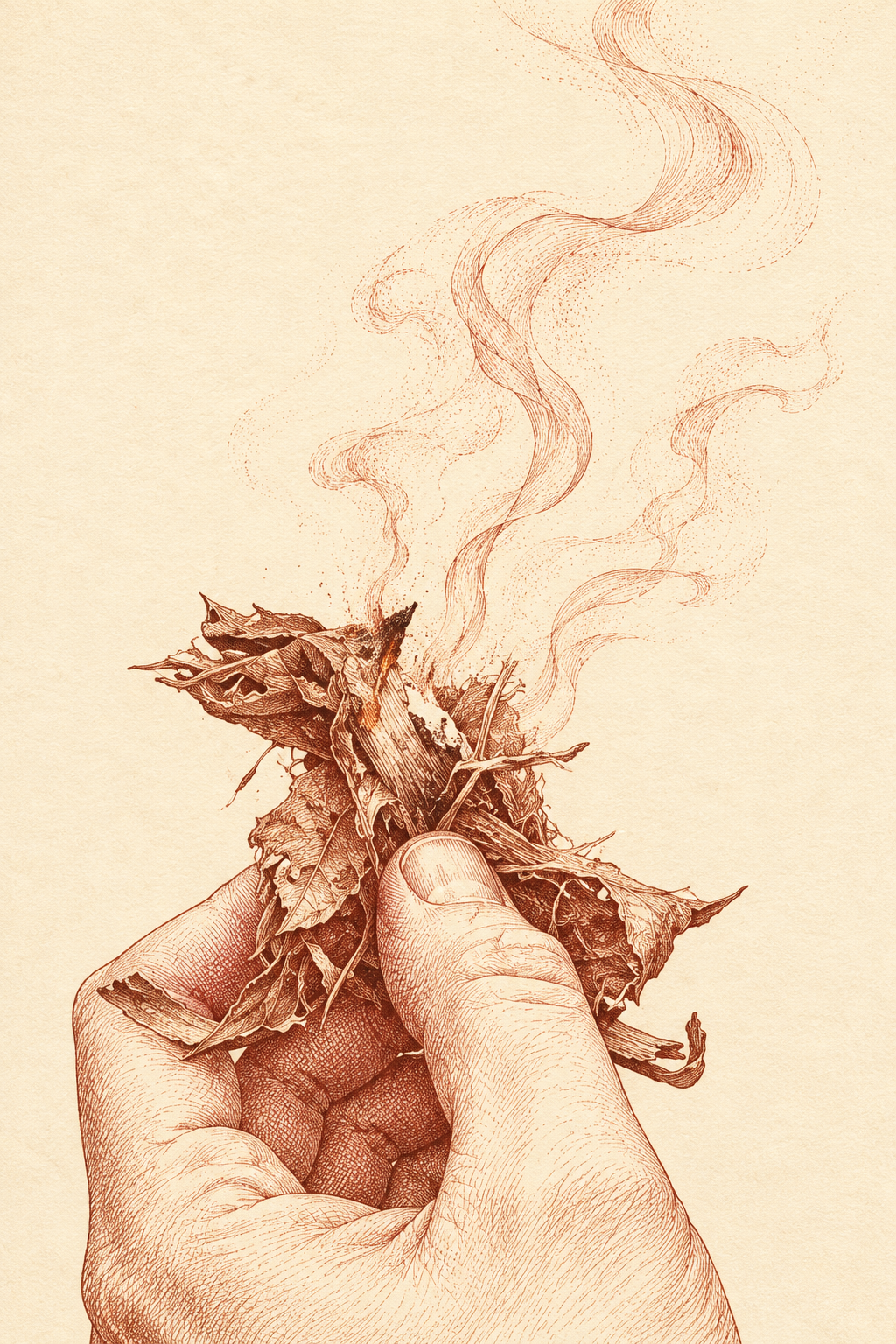
Within Fyrnsegen this newly kindled fire is called nýdfýr, the need-fire. Wood is worked against wood until an ember forms; tinder receives it, breath strengthens it, and the first flame is given fuel. Through this work the holy fire of the wíh is established, and from that source the further work of hallowing proceeds.
The making belongs to the rite. The heargweard must understand the materials, recognise the ember, and bring the flame to a condition in which it can be borne and maintained. His first instruction therefore joins knowledge of the sacred with a craft learned through repeated work.
The Nýdfýr chant accompanies the kindling; its invocation is repeated while the ember is brought forth, and its closing words are spoken as the new fire is placed in the wíh.
An inherited practice
The history of the need-fire
An early witness occurs in the eighth-century Indiculus superstitionum et paganiarum, a Christian list of practices condemned as pagan. Its fifteenth entry reads De igne fricato de ligno id est nodfyr: “Concerning fire rubbed from wood, that is, nodfyr.” The entry identifies both the method and the name; its presence among religious prohibitions places the practice beyond ordinary household fire-lighting.1
Later accounts preserve need-fire as a communal response to danger, especially disease among livestock. Frazer’s collection describes households extinguishing their fires, a new fire produced by friction, and animals brought through or between fires believed to protect them. Flame was then taken home to renew domestic hearths. The apparatus varied: ropes, wooden rollers, wheels, and planks appear in different places; rules concerning the people who performed the work varied as well.2
Martin Martin, writing of the Western Isles of Scotland in 1703, records a particularly striking example. Eighty-one married men worked in groups of nine to produce fire from two wooden planks after the parish fires had been put out; each household then received new fire from the common source. His account shows the renewal of the household hearths bound to a shared act of labour.3
These witnesses come from different centuries and communities. They preserve a recurring concern with how a fire begins and what may proceed from it; they do not supply one complete Anglo-Saxon ritual. In Fyrnsegen we use the form nýdfýr for the fire made through this inherited principle of friction-kindling. The continental spelling nodfyr remains in quotations from the historical sources.
Fresh fire and sacred use
What Grimm recognised
Jacob Grimm’s discussion in Teutonic Mythology, under “Elements,” begins with the distinction between an existing fire passed from hearth to hearth and a flame newly generated for sacred use. He compares the latter to water freshly drawn at its source; the history of the substance matters to its fitness for the work.4
Grimm calls this new fire wild in contrast to the domesticated flame. He acknowledges that striking stone can also produce fresh fire, but suggests that generation through wood was regarded as especially ancient and hallowed. He assembles accounts of friction-kindling, extinguished hearths, and communal renewal, and interprets the need-fire as a survival connected with heathen sacrifice.
His explanation gives us a useful theological starting point: sacred work can require a beginning of its own. Grimm’s reconstruction remains an interpretation of the evidence he gathered; the place we give nýdfýr within the wíh belongs to Fyrnsegen’s theology.
Fyrnsegen’s understanding
The holy fire of the wíh
The sanctuary begins with a particular fire made for a particular work. Its flame has not been borrowed from an established hearth; its first ember is brought forth in the preparation of the sacred centre. The heargweard knows its beginning because he has taken part in making it, and its continuance passes into his care.
Within our theology, wéoh names the divine quality borne in the living fire, and the wíh is its central seat. The surrounding hearg becomes hálig through the proper extension of that power. Together the wíh and hearg form the ealh, the whole sacred enclosure.5
Nýdfýr belongs at the beginning of this relationship. Its making establishes the fire from which the torch receives its flame; when the heargweard carries that torch around the hearg in Wéohende, the fire at the boundary remains continuous with the fire at the centre. The source continues to burn while its sacred consequence is extended through the enclosure.
The procession joins flame, speech, movement, and the conduct of those gathered. Þunor is invoked in the establishment of the bounds; those within are charged to keep frið, and those whose presence would disturb the sanctuary are commanded to depart. The fire’s origin gives the procession its living source, while the completed deed establishes the surrounding field in its appointed condition.
Our association with Þunor follows this work of establishing and defending order. His thunderbolt brings fire to earth; in Wéohende he is called upon as the fire passes around the enclosure. This is the relationship articulated in our rite, rather than a claim that every historical need-fire was addressed to Þunor.
The labour of friction-kindling gives this theology a practical demand. The materials must be prepared, the ember brought forth, and the flame sustained; each depends upon attention to conditions that cannot be supplied by declaration alone. A practice fire teaches those conditions. In the rite, the same craft is placed in service of the wíh and the sacred order established from it.
The heargweard’s competence includes restraint. He must be able to judge the weather and the ground, keep the fire within its appointed hearth, and recognise when conditions do not permit the work. Control begins with preparation and remains his responsibility for as long as the fire is in his keeping.
The rune in the work
The fire-bow and Nied
In Fyrnsegen we make nýdfýr with a hand bow, also called a fire-bow or bow drill. We recognise in the upright spindle and the bow crossing it the form of Nied ; the rune is recalled in the very apparatus by which the fire is brought forth.
For us, the connection joins name, form, and deed. Nýdfýr is need-fire; the heargweard works with the crossed wood to bring its ember into being, then tends that beginning until it can sustain the holy fire of the wíh. The rune’s place in this lesson is therefore bound to a craft that must be learned and performed.
The hand-bow method
Bringing forth the ember
The bowstring turns the spindle while a bearing block, held in the other hand, supplies downward pressure. Heat and wood dust accumulate at the hearthboard until an ember forms; the ember then passes into tinder and is raised to flame. Begin with a proven, dry set and practise with an experienced fire-maker where possible.
Sing the chant during the kindling. While working the bow to bring forth the ember, repeat “Wéoh, wéoh, weorð on worulde”—“Wéoh, wéoh, come into being in the world.” Let the refrain accompany the work until a lasting ember has formed. Once the tinder nest bearing the new flame is placed in the prepared hearth of the wíh, speak “Hér weorðe wíh”—“Here let the wíh come into being”—once, and pause.
What to have ready
- Bow and cord
- A sturdy, slightly curved stick about an arm’s length, with strong, low-stretch cord secured at both ends. Leave enough slack to twist in the spindle; once fitted, the cord must grip it.
- Spindle
- A straight, dry wooden shaft, roughly a handspan long and thumb-thick. Shape a narrower upper end for the bearing block and a broader, blunt working end for the hearthboard.
- Hearthboard
- Dry, sound, untreated wood with a flat underside and room for a foot beside the socket. Choose a proven wood pairing; willow or poplar can make suitable practice sets.
- Bearing block
- A comfortable handhold of hardwood or a suitable stone, with a hollow to steady the spindle’s upper end. This contact should turn freely; keep any lubricant confined to the upper bearing.
- Tinder, catcher, and fuel
- A nest of dry fibres with fine material at its centre; thin bark to catch and carry the ember; a knife; and dry kindling graded from fine twigs to larger sticks.6
Prepare the tinder and receiving hearth
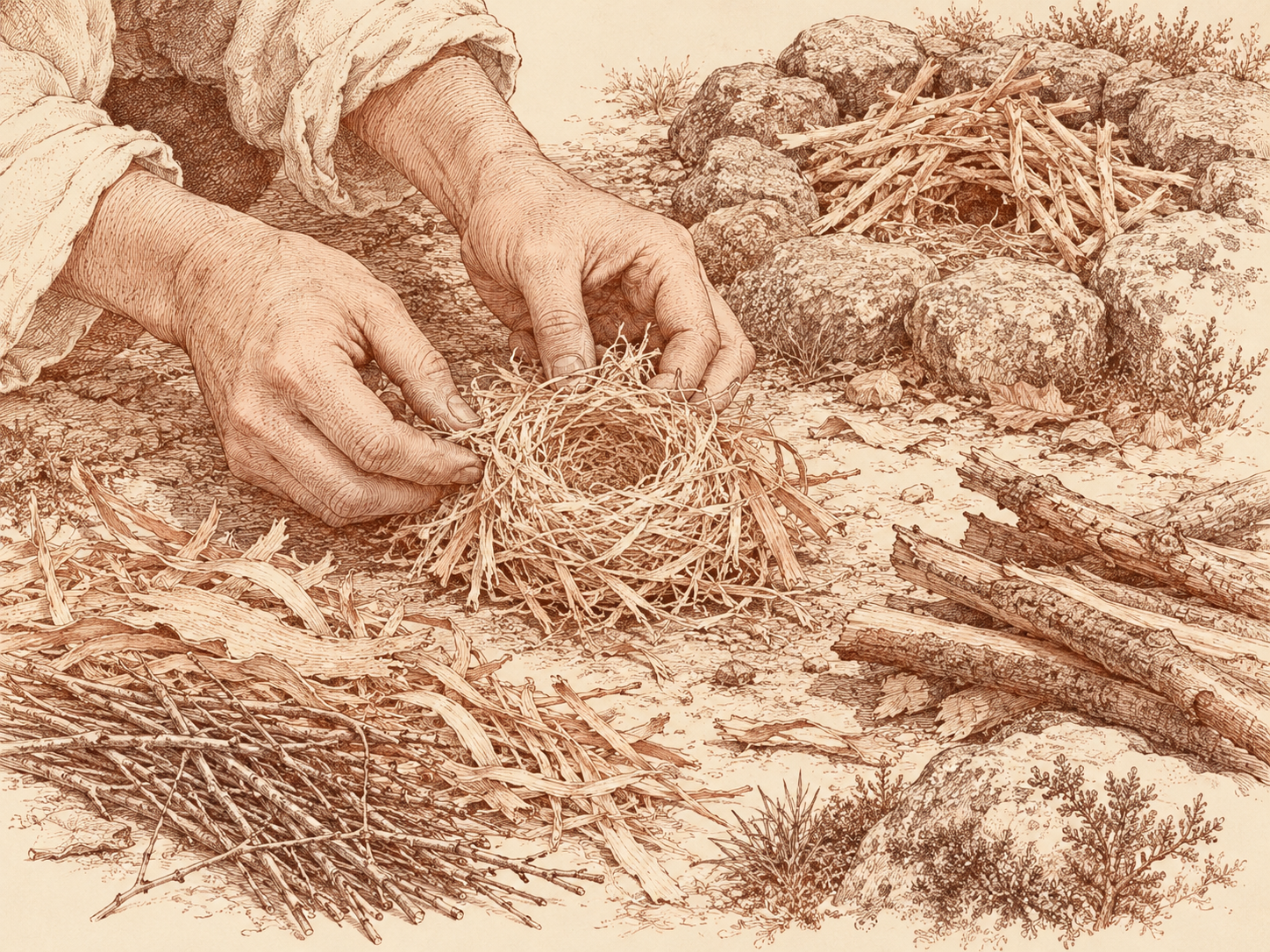
Make a pocket in the finest tinder and keep the bundle within reach. Arrange fine kindling in the prepared hearth with space to receive the burning bundle and admit air.
Prepare the tinder before beginning the drill. Mark the socket
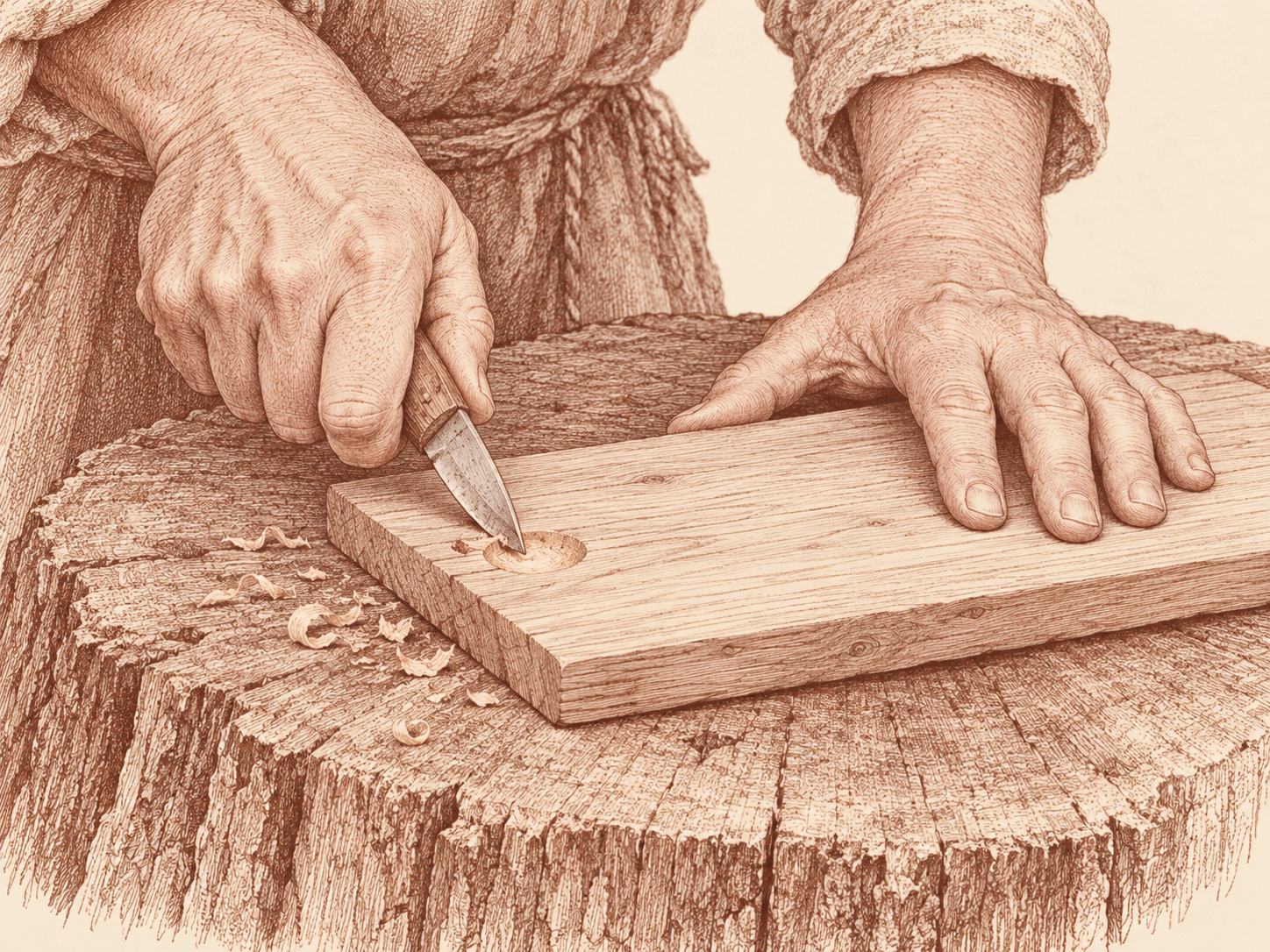
Carve a shallow depression near the hearthboard’s edge, leaving enough wood around it to contain the spindle. Set the knife aside before assembling the drill.
The starter socket sits close to the hearthboard’s edge. Fit the spindle and brace the set
Twist the spindle once into the bowstring, keeping it outside the bow so the cord lies between spindle and bow. For a right-handed worker, hold the board with the left foot, kneel on the right knee, and take the bearing block in the left hand. Seat the spindle upright; brace the left wrist against the shin and hold the bow in the right hand. Reverse these positions if left-handed.7
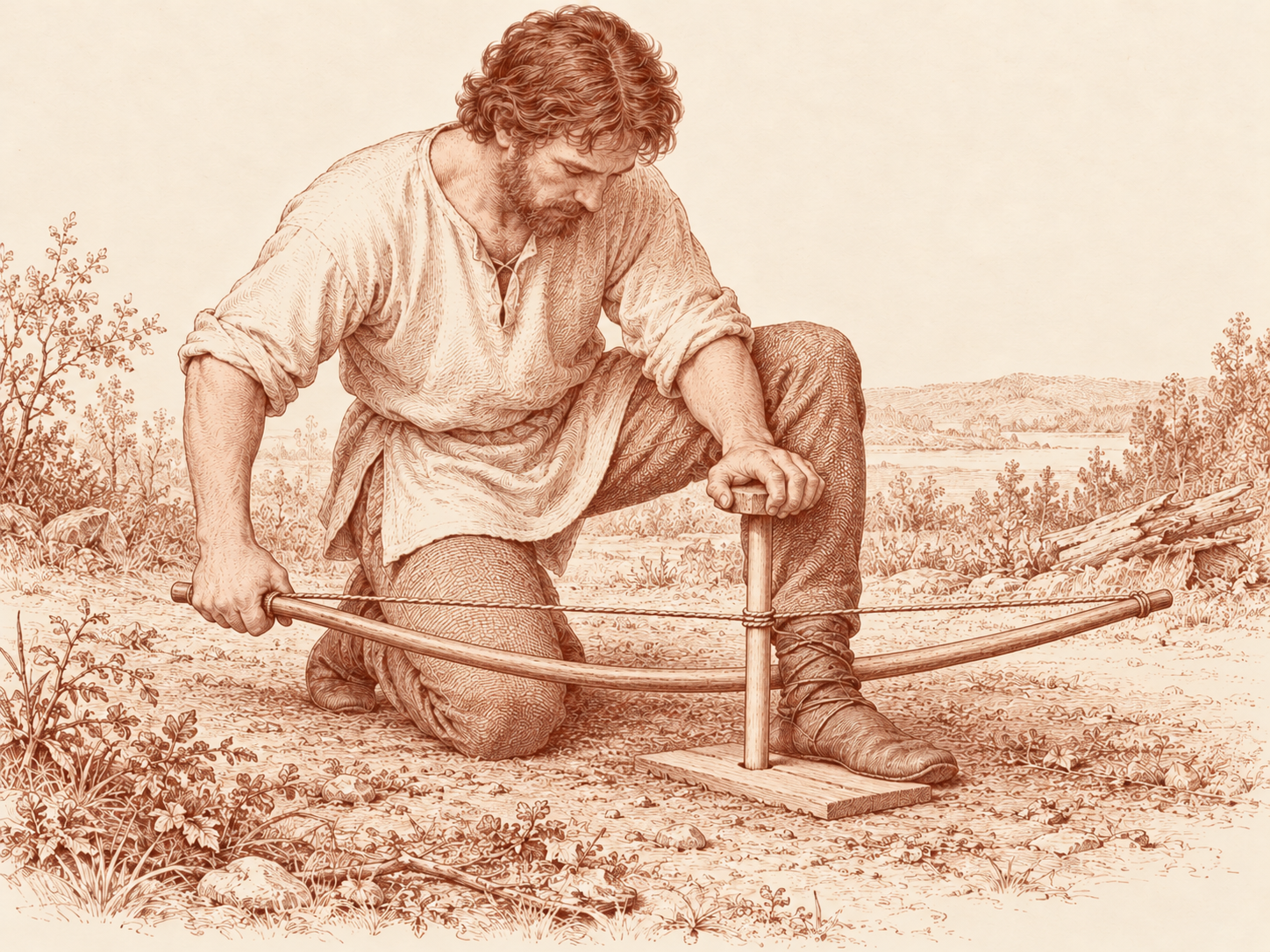
Brace the bearing hand and keep the spindle upright. Burn in the socket
Press down through the bearing block and draw the bow slowly back and forth. Keep it level so the cord stays at one height. When the spindle has made a dark, fitted socket, stop and put down the set.
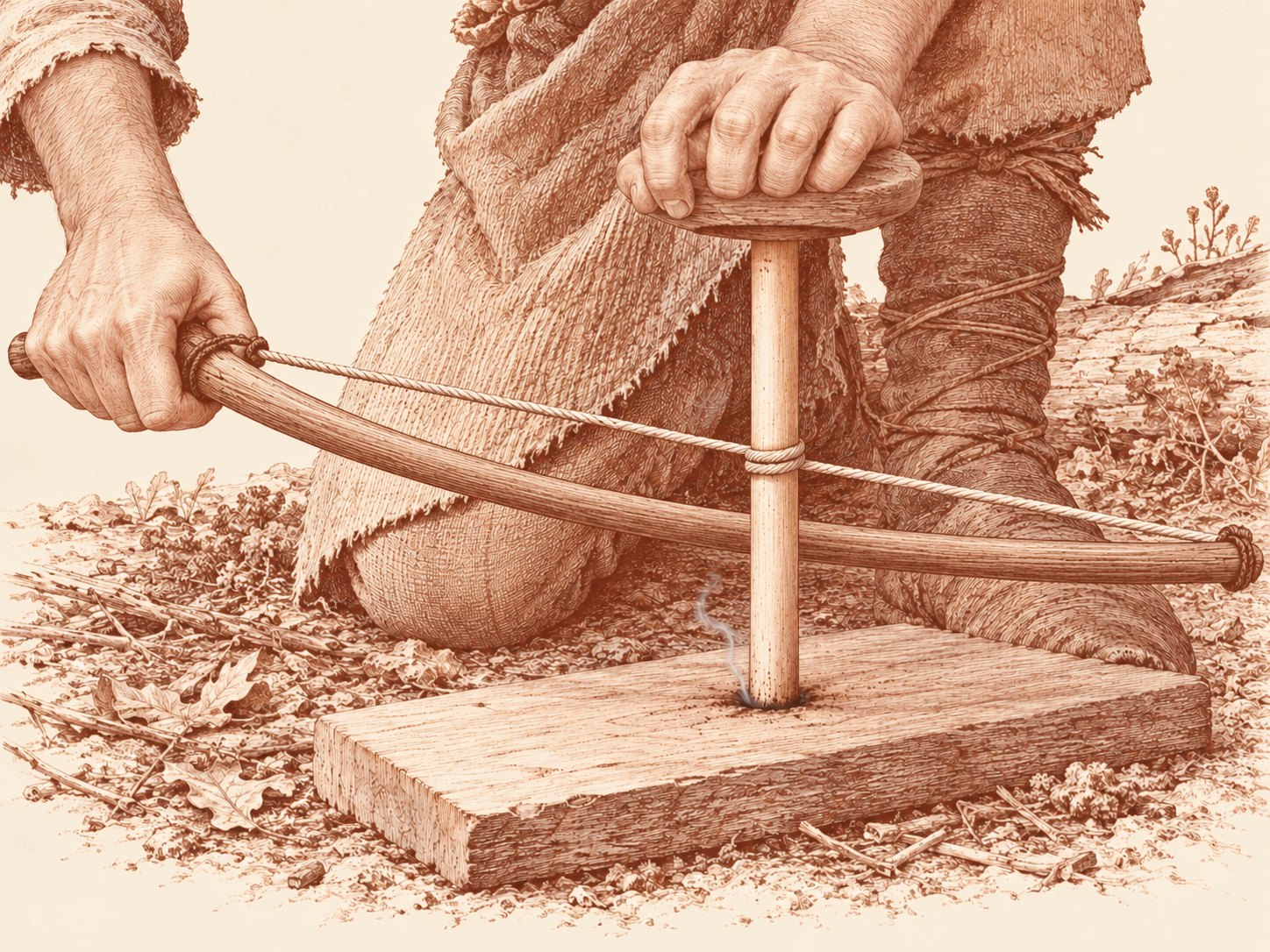
Burn in a fitted socket with slow bow strokes. Cut the dust notch
Cut a V from the board’s edge towards the socket’s centre, stopping just short of it; approximately one-eighth of the circle is a starting width. Place the catcher beneath the notch, then reassemble the set.
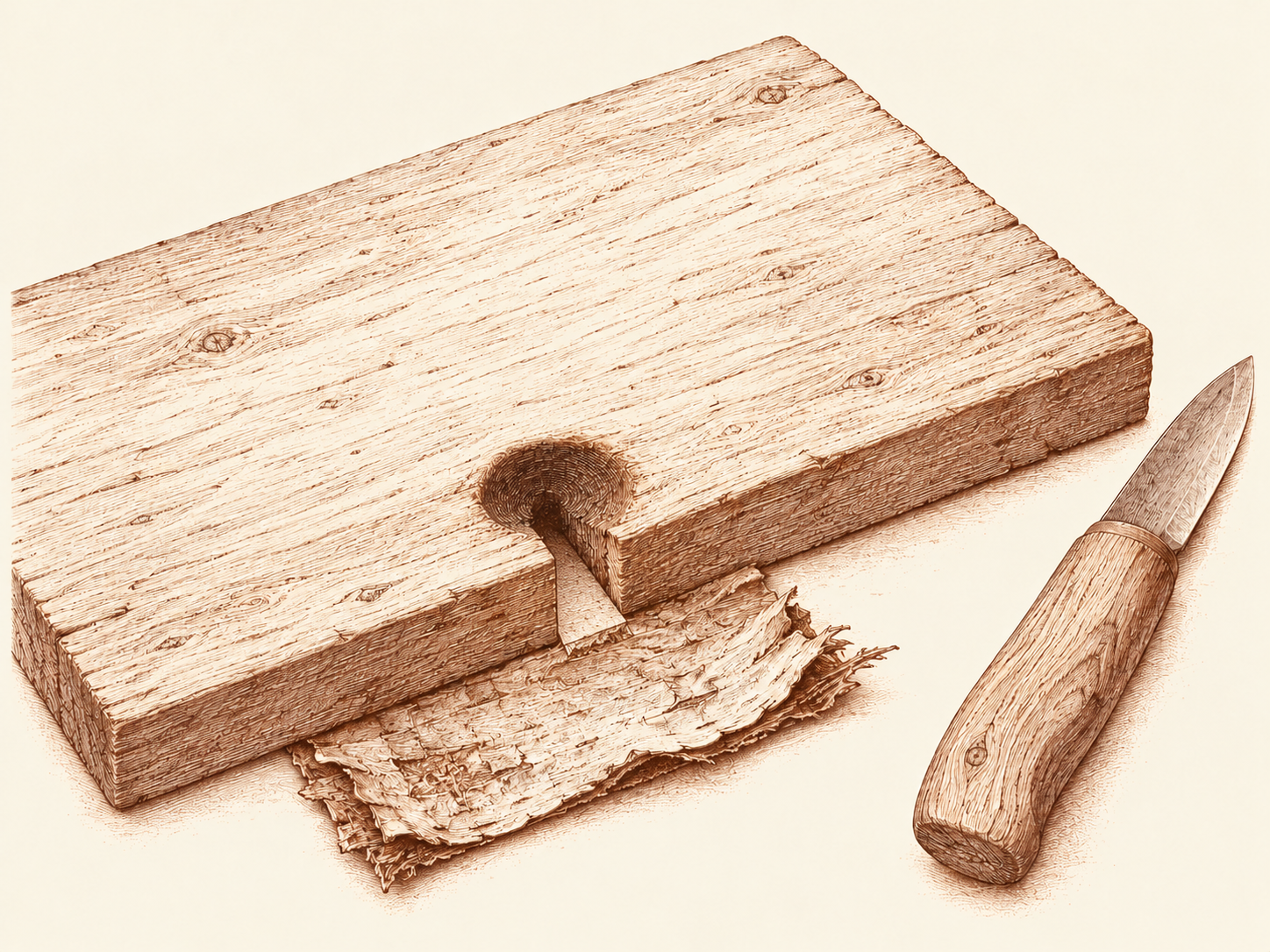
An open notch lets hot dust collect on the catcher. Bow until the dust holds an ember
Use smooth, long strokes; increase speed and downward pressure as heat builds. Let the notch fill with dark dust. Smoke from the spinning wood alone is insufficient; look for a dust pile that keeps smoking after you stop. During this work, repeat the invocation “Wéoh, wéoh, weorð on worulde”; bring the repetition to a close when a lasting ember has formed.
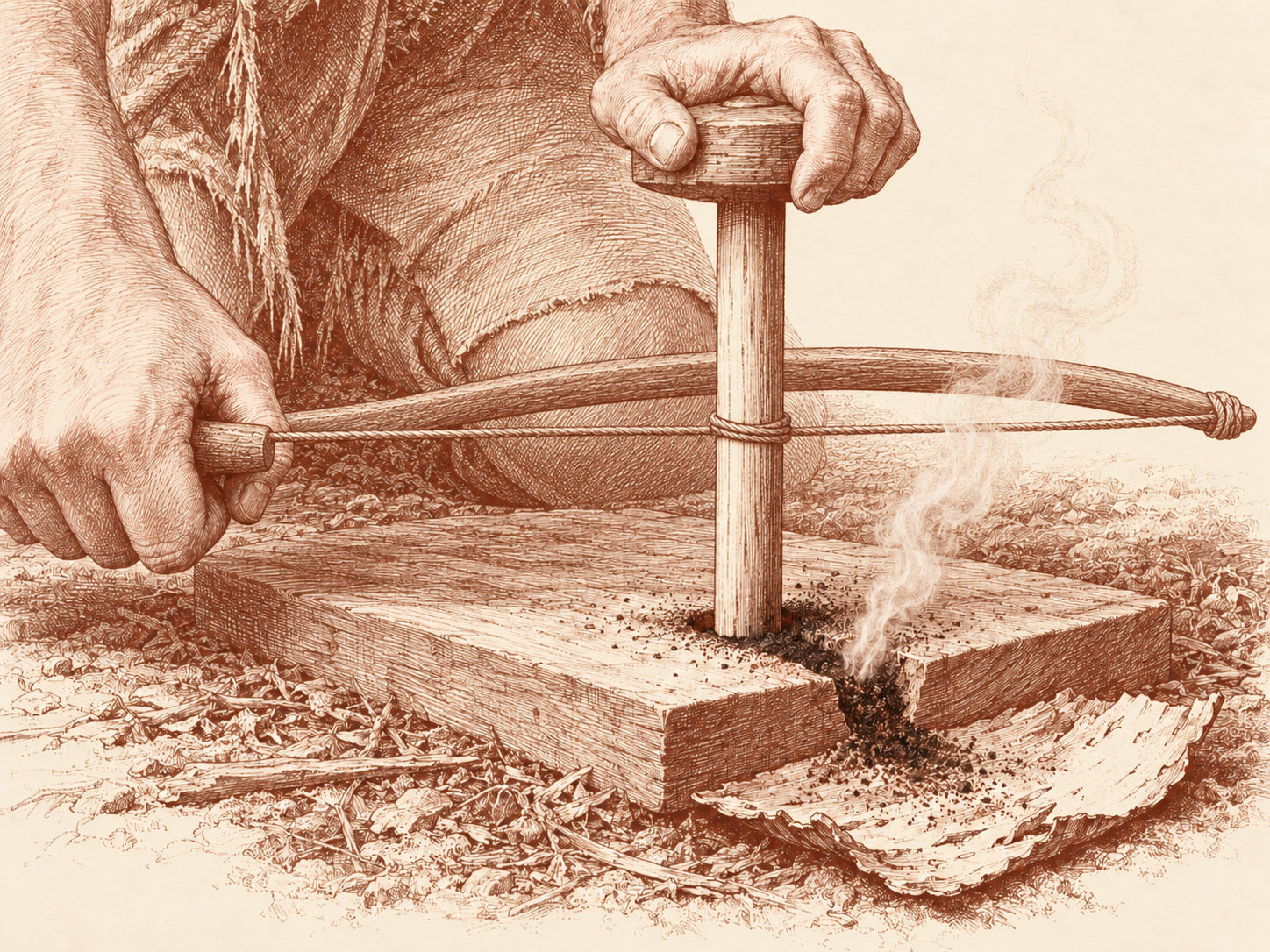
The dust must hold an ember of its own. Lift and transfer the coal
Remove the spindle gently. Free the board without scattering the dust and allow the coal to strengthen. Slide it from the catcher into the tinder’s fine centre, preserving the ember as one piece.
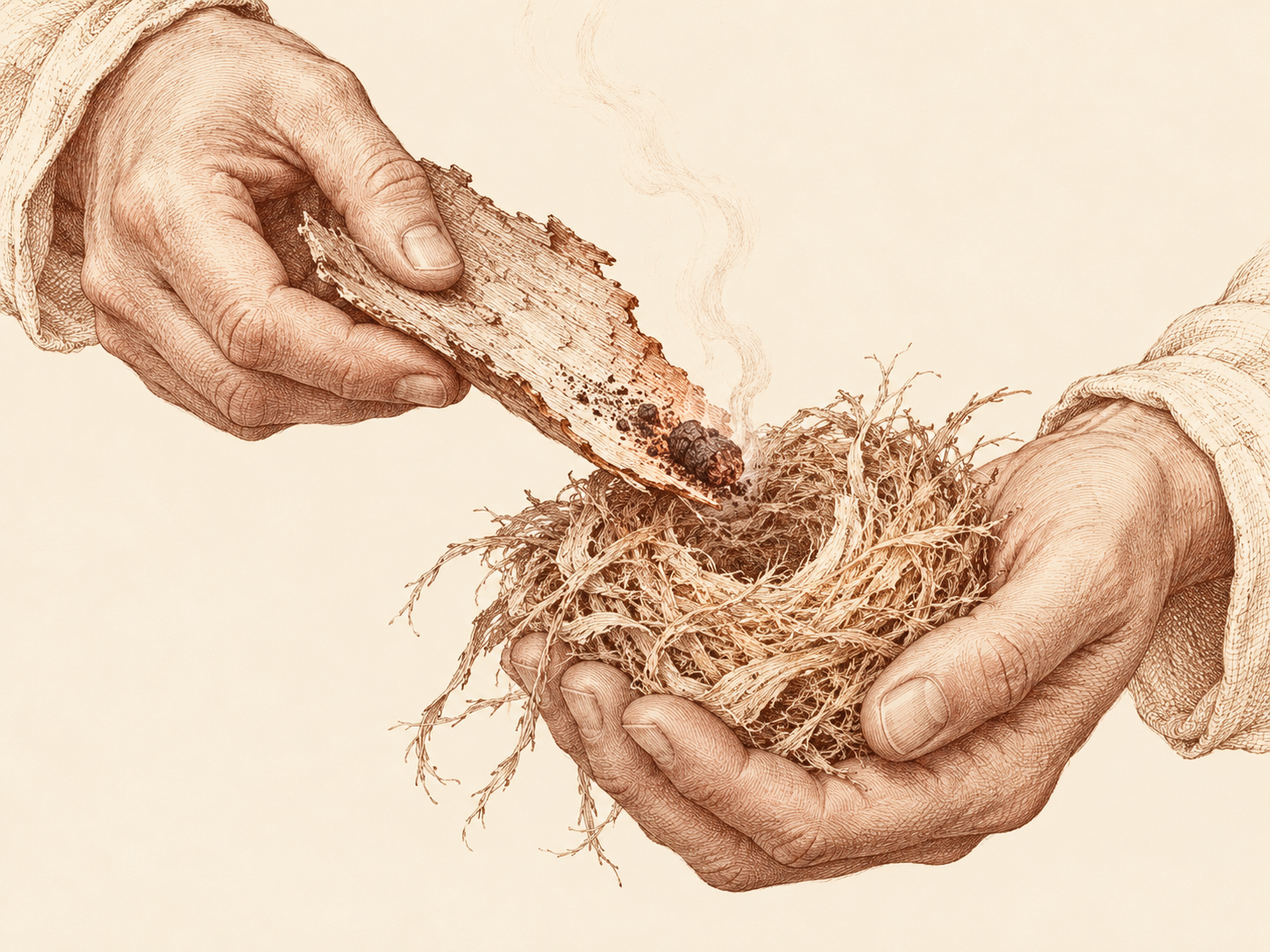
Keep the coal together as it passes into the tinder. Raise flame and feed it
Fold the tinder loosely around the coal. Blow steadily into it, increasing the airflow as the glow spreads. Keep smoke and rising heat away from your face. Once it flames, place it in the prepared hearth of the wíh. With the nest in place, say “Hér weorðe wíh” once; pause, then tend the new flame, adding fine kindling followed by larger sticks.
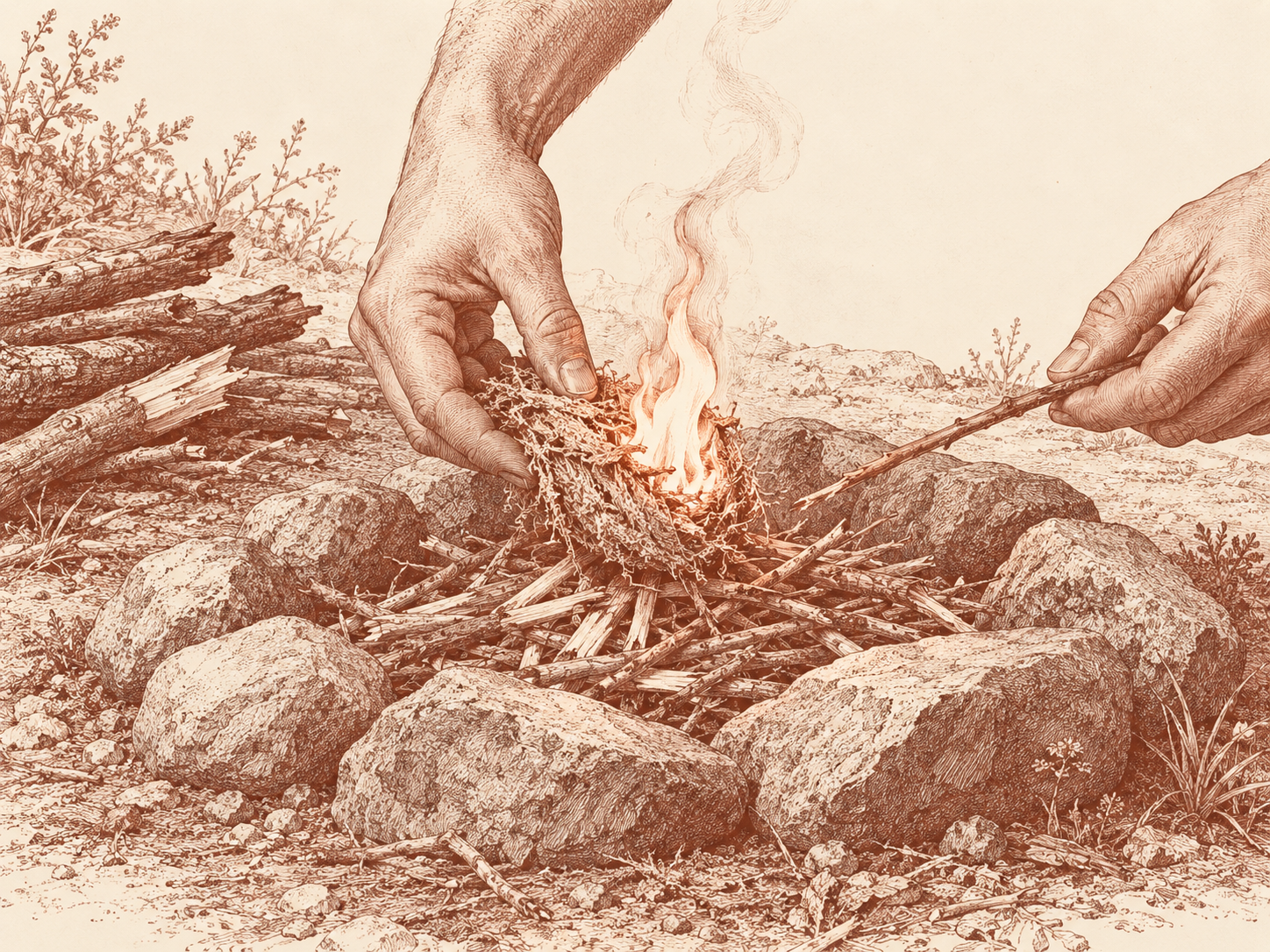
Feed the new flame with fine kindling.
Learning from an unsuccessful attempt
| What you see | What to check |
|---|---|
| Cord slipping | Adjust tension; use sound cord that grips the spindle. |
| Spindle wobbling or jumping out | Brace the bearing hand against the shin and keep the spindle vertical. |
| Heat at the upper bearing | Reduce drag there; the working friction belongs at the hearthboard. |
| Pale dust or squeaking | Check for glazing and insufficient pressure. |
| Smoke stops with the bow | Check dryness, rhythm, and dust accumulation; a lasting ember has yet to form. |
Adjust one part of the set or movement at a time; repeated practice makes the relation between pressure, speed, and the condition of the wood easier to recognise.8
Words for the kindling
The Nýdfýr chant
The chant accompanies the making of nýdfýr; its invocation is sung repeatedly as the bow is worked and the ember brought forth. Once the tinder has taken flame and is placed in the wíh, the closing words mark its establishment. The accompanying page gives the Old English, translation, and order of working.
The heargweard’s charge
From kindling to keeping
In practice, learn the whole passage: prepare the materials, make the ember, raise a flame, sustain a small controlled fire, and extinguish it completely. Repeat the work until success is dependable; a ceremony should not be the first occasion on which the materials are tested.
For the rite, the new flame is established in the prepared hearth of the wíh and maintained there. Once it can support the work, the torch receives fire from that source for Wéohende. The central flame remains in the keeping of the sanctuary while the heargweard carries its fire along the boundary.
When the fire’s appointed work is finished, attend to the remaining embers with the same care given to its beginning. Douse and stir them, then repeat until the ash and fuel are cold; a quiet hearth can still contain heat capable of starting another fire. The heargweard answers for what remains as well as for what has been kindled.9
The first lesson therefore continues throughout the office. To make nýdfýr is to undertake the care of a living fire; to keep it well is part of keeping the place entrusted to it.
Notes & sources
- Indiculus superstitionum et paganiarum, §15, eighth century. Latin text; the translation above is our own. The entry is also discussed by Grimm, vol. II, pp. 603–604. It is continental evidence, rather than a surviving English service order. ↩
- James George Frazer, The Golden Bough, abridged edition (1922), chapter 62, §8, “The Need-fire.” His comparative collection records beliefs about protection and disease; these are historical beliefs, not medical or veterinary instructions. Practices involving passage through fire are not part of the method taught here. See also the introductory need-fire overview. ↩
- Martin Martin, A Description of the Western Islands of Scotland (1703), “The Ancient and Modern Customs of the Inhabitants of the Western Islands of Scotland.” The number and marital status belong to this particular account; they are not requirements given for Fyrnsegen’s practice. ↩
- Jacob Grimm, Teutonic Mythology, trans. James Steven Stallybrass, vol. II (1883), chapter XX, “Elements,” especially pp. 603–610; the discussion begins on p. 603 and continues into comparative material on pp. 611–612. English volume (PDF); German text. ↩
- Fyrnsegen, “Wéohende: Living Fire and the Establishment of the Ealh.” The distinctions between wéoh and hálig, the wíh and hearg, and the relationship to Þunor are the tradition’s stated theology. ↩
- Ford Church / Cottonwood Institute, “Friction Fire,” for the bow-drill components, tinder, and fuel; Forest Fundamentals, “How to Use a Bow Drill for Fire by Friction,” for material selection, cord tension, and the passage from ember to flame. Sizes are practical starting points. ↩
- Woodland Ways, “Bow Drill — How many things could be ‘just not quite right?’: Stance.” Guidance on footing, wrist support, spindle alignment, and bow position. ↩
- Sacred Hearth Friction Fire, “Bow Drill Step by Step Method,” for burning in, notch geometry, ember recognition, and troubleshooting; read alongside the practical sources in note 6. The connection between the hand bow and Nied is Fyrnsegen’s stated understanding of the practice. ↩
- National Park Service, “Minimize Campfire Impacts.” Keep fires small, observe local restrictions, and extinguish all embers completely. ↩