
Lore of the Hwítmerscingas
Where the Profane Cannot Profane
Iron, Holy Fire, and the Paradox of the Wíh
Iron and Mortal Flesh
Iron profanes the wíh because iron is profane; its exclusion follows from what it is. Within the theology developed here, iron shares the condition of mortal flesh. It can be strong, useful, and enduring, yet it remains subject to corruption and dissolution. Rust makes that condition visible. The iron’s red wasting discloses a susceptibility already present in the sound metal, just as the decline of a human body reveals the mortality that belonged to it throughout its life. This understanding gives substance to the prohibition and explains why an apparently clean iron object can still profane the sacred enclosure.
The comparison between bronze and iron helps us apprehend this difference. Bronze, the older of these two traditions of working metal, can acquire a patina through which the object continues to endure. Age changes its surface while leaving its form recognizable; the vessel, image, or implement remains available to those who inherit it. Iron presents another familiar course of ageing. Its red corrosion can spread, flake, and consume the substance beneath, until the object loses the integrity upon which its usefulness depended. These are characteristic appearances through which the metals may be understood religiously, although the preservation of any particular object depends upon its composition and circumstances.1
The religious force of the comparison lies in the different relationships to time that these appearances disclose. Bronze can seem to gather age upon itself and retain its form beneath it; iron can seem to waste away through the very substance of its body. We need not claim that bronze is incapable of destruction in order to recognize endurance in its patina, or that every piece of iron must decay at the same rate in order to recognize corruptibility in its rust. The material encounter gives the theological understanding its language. The argument rests upon the religious significance of that encounter, rather than upon an absolute division that metallurgy would be unable to sustain.
Iron’s kinship with flesh is especially apparent in its “bleeding.” The red stain spreads from the metal as blood spreads from a wound; the hard surface opens, sheds, and loses what had seemed securely held together. In this resemblance, iron participates in the same condition that we recognize in ourselves: strength exists within a body that can fail, and integrity must eventually contend with dissolution. Calling this bleeding expresses a religious understanding of the metal’s nature. Its significance reaches beyond the colour alone to the vulnerability that the colour reveals.
Rust therefore does not first make iron profane. It manifests the corruptibility through which we understand iron as belonging to the profane condition. A polished blade and a corroded nail share that nature, despite their very different appearances; removing the visible rust does not remove the condition that made rust possible. The comparison with human mortality makes the distinction clear. A healthy person is already mortal, and cleansing a person does not make that person cease to be mortal. In the same way, iron may be cleansed without ceasing to possess the nature that makes cleansing necessary.
Iron and Sacred Space
Greek and Roman practices provide comparisons for this understanding of material fitness within sacred space. Their testimony concerns particular sanctuaries and their requirements; the theological explanation offered here belongs to our understanding of the wíh. Roman templum is itself a technical term for a space defined through augural procedure, and should not stand indiscriminately for every shrine or sacred grove. The comparisons become more useful when we attend to the places, objects, and acts that each source actually names.2
Among the clearest Roman examples is the grove of Dea Dia, whose rites were maintained by the Arval Brethren. Their inscribed records include expiatory sacrifices associated with bringing iron into the grove and taking it out again. The purpose named in these entries is writing and engraving, the work of cutting the fraternity’s records into stone; the offerings include a pig and a ewe-lamb. An iron tool employed in the service of the cult still occasioned a piaculum, an expiatory offering. Its usefulness did not settle whether it could enter the sacred ground without ritual provision.3
The Arval evidence preserves a distinction important to the wíh: serving a sanctuary does not by itself make every instrument fit to enter it. Good purpose can coexist with a religious consequence that requires expiation. A related document, the dedication law of Jupiter Liber’s temple at Furfo, dated to 58 BCE, expressly permits the use of iron among the operations allowed upon the building. Its wording shows that a sanctuary’s dedication could provide for such interventions, although this particular permission does not establish a universal Roman prohibition.4
On Delos, a regulation for the sanctuary of Zeus Kynthios and Athena Kynthia lists both an iron finger-ring and weapons of war among the things an entrant must not carry. The ring deserves attention because a restriction extending to it cannot be explained solely as a practical precaution against armed violence. Material and kind of object both enter the regulation. The inscription does not supply an explanation in terms of corrosion, but it does furnish a comparison for the religious significance of iron beyond its use as a weapon.5
At Eresos on Lesbos, another sanctuary regulation forbids bringing iron into the temple building. Its next provision excludes copper or bronze except coinage; footwear and other leather also appear among the prohibited items. Here the rule expressly concerns material, while also showing that bronze was not invariably admissible wherever iron was excluded. The comparison with bronze developed in this paper must therefore remain an account of how we understand the metals within our theology, without being attributed to every ancient sanctuary that regulated their admission.6
Tacitus supplies a Germanic comparison in Germania 40. Describing the procession of the divinity he calls Nerthus, worshipped by a group of peoples that includes the Anglii, he writes clausum omne ferrum: literally, ‘all iron is shut away.’ He places this statement beside the cessation of warfare and the laying aside of arms. Since ferrum can also stand for weapons, the passage leaves the full material scope uncertain; what it clearly describes is a withdrawal of iron or weaponry during divine visitation. The arrival of the deity changes what the community may do and what it may keep at hand.7
Taken together, these comparisons show that an object’s ordinary usefulness does not exhaust its religious character. Entry, handling, and proximity to divine presence can require exclusion, express permission, or expiation. They give historical substance to the question of iron’s place in sacred space. Our answer to why iron profanes proceeds from the religious understanding already set out: iron bears the condition of corruptible flesh, and its admission to the wíh therefore requires more than a practical reason for bringing it there.
The Grate and the Holy Fire
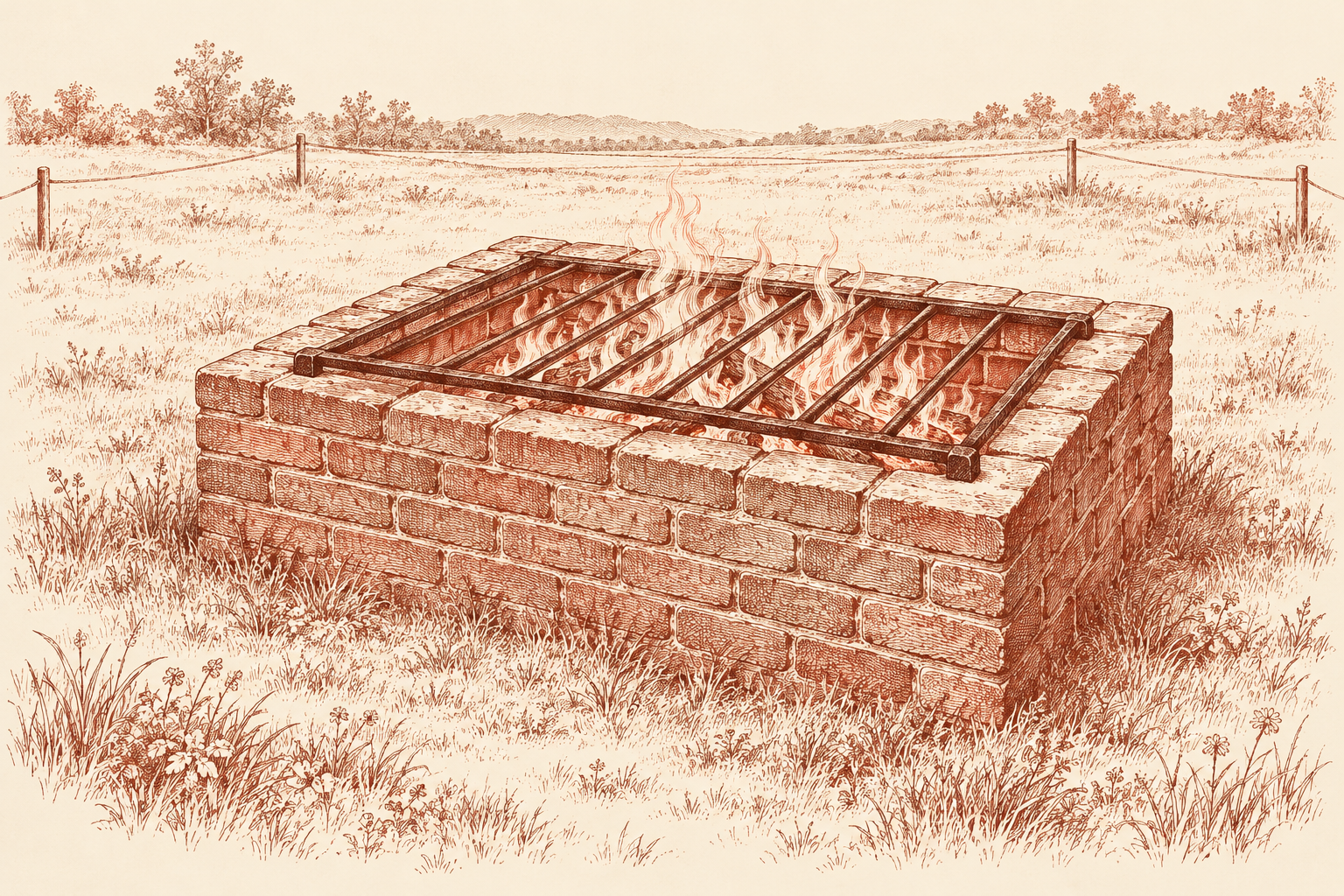
The hearth grate makes that requirement unavoidable. Iron stands over the fire that is the source and embodiment of wéoh within the wíh. If iron is profane by nature, its presence at this centre demands an explanation that takes its nature seriously. The explanation lies in the holy fire’s continual action. The fire cannot itself be profaned; the iron grate remains constantly subject to the cleansing power of the wéoh embodied in it.
This requires a distinction between the sacred condition of the enclosure and the holy power present at its centre. The wíh has conditions of approach that can be violated. The fire is the source of the cleansing through which profane things may be brought into a fitting relation with the holy. Iron can profane the maintained condition of the space, while remaining unable to profane the fire itself. The fire’s action upon the grate follows from this difference: the holy power continues to cleanse the corruptible substance held over it.
The grate remains iron throughout that action. Cleansing does not remove its susceptibility to rust, nor must it transform the metal into another substance. Its corruptible nature persists while its religious condition is continually maintained by the fire. Here the analogy with mortal flesh returns with particular force. A person can undergo purification and approach the holy while remaining mortal; the purification establishes a fitting condition for that approach without abolishing the person’s nature. So too the grate can be cleansed without becoming incorruptible.
Continual cleansing is therefore essential to the account. A single act of purification would not explain why iron had permanently lost its capacity to profane; the grate’s place at the hearth brings it within an ongoing action of wéoh. Its nature explains the continuing need, and the nature of the holy fire explains how that need is met. The relation is sustained by the fire’s power, which remains capable of cleansing the iron without itself becoming subject to profanation.
This understanding also gives the grate’s presence its proper limits. Its service at the hearth places it in a particular relation to holy power. An iron tool carried elsewhere within the enclosure cannot claim the same condition merely because it is useful, or because another iron object is already present. The distinction concerns the action under which the grate stands. As the Arval records suggest in their own setting, service to the sanctuary does not dispense with the religious consequences of the material employed.
The hearth thus brings together two truths about iron that would appear contradictory if nature and maintained condition were treated as the same thing. Iron belongs to the corruptible order of mortal flesh, and the holy fire continually cleanses the iron held over it. The grate’s presence follows from the activity of wéoh upon what remains profane by nature. Through this relation, the hearth reveals both why the wíh requires protection from profanation and how the holy power at its centre makes the presence of the iron grate possible.
Notes and Sources
Patina is itself a product of corrosion. Stable, adherent layers can slow further change in copper alloys; bronze can also undergo destructive active corrosion, including bronze disease. Iron likewise sometimes develops stable corrosion layers. The contrast in the text concerns recognizable modes of ageing, not an invariable law of preservation or a chemical proof of religious status. See Canadian Conservation Institute, “Recognizing Active Corrosion,” CCI Notes 9/1. Conservation guidance
↩ Return to textOn templum as an augural term, see the entry “Templum” in the Oxford Classical Dictionary. The Arval evidence below concerns a lucus, or sacred grove. Oxford Classical Dictionary
↩ Return to textActa Fratrum Arvalium, including CIL VI 2099, records ob ferri inlatum and ob ferri elationi in connection with scriptura et scalptura. Consult the Latin corpus for the individual entries; spelling and restorations vary. Latin inscriptions
↩ Return to textLex a vicanis Furfensibus templo Iovis dicta, CIL IX 3513 = CIL I² 756 = ILS 4906, opening dedication provisions. The text permits iron use among specified building operations. Latin text
↩ Return to textI.Delos 2529, especially the entry restrictions in lines 12–26. See Jon D. Mikalson, Religion in Hellenistic Athens (University of California Press, 1998), chapter 7, discussion of Zeus Cynthios and Athena Cynthia, for translation and context. The precise date is uncertain. Text and discussion
↩ Return to textIG XII Supplement 126 = LSCG 124, lines 15–17. Greek text reproduced in A.-M.-S. Karatas, “Greek Cults and Their Dress-Codes,” Revue des Études Anciennes 122.2 (2020), p. 466. The paraphrase here follows the Greek: nomisma is coinage; the rule names the temple building. Published Greek text
↩ Return to textTacitus, Germania 40. The rendering of clausum omne ferrum is literal; translations often render ferrum contextually as “weapons.” The identification of the deity follows Tacitus’s wording and does not settle subsequent theological identifications. Latin text
↩ Return to text