Lore of the Hwítmerscingas
Wægn ran æfter
Ing and the Continuance of Kingship
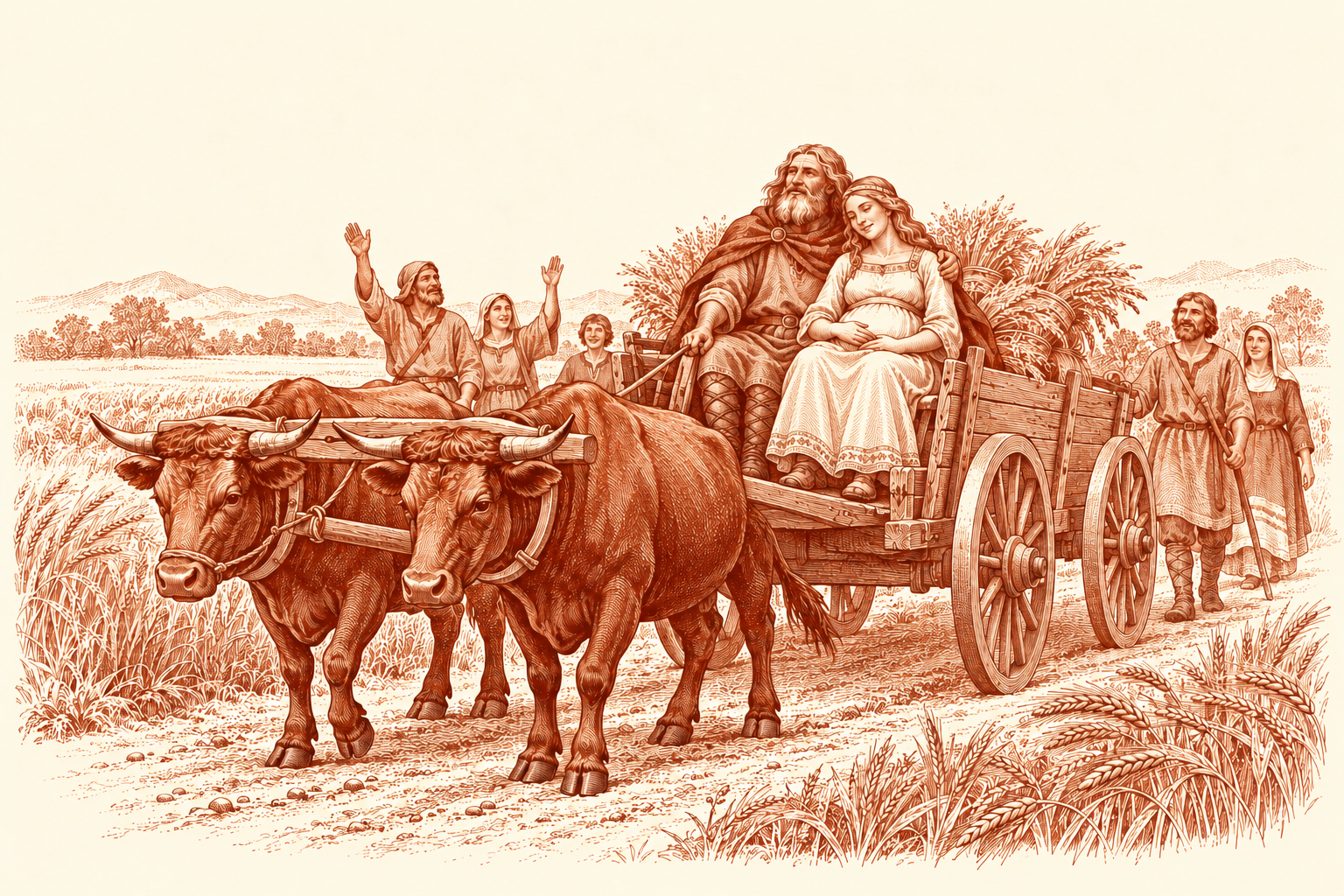
Ing departs over the wave; afterward, the wagon runs. Read in this way, the enigmatic movement at the end of the Ing stanza becomes a declaration of what continues among the people after the god has withdrawn from their sight. His going does not exhaust his relation to the land. The wagon carries that relation into the life of the community, making the king’s presence available through procession. We propose that the stanza compresses this passage from remembered encounter to continuing observance into the few words wæn æfter ran.1
The argument begins with the reading developed in What the Names Keep. There, the ambiguity of æfter is set beside the northern accounts of Freyr and Fróði, whose deaths do not immediately end the prosperity, tribute, or authority associated with them. The present paper develops the consequence of that comparison. Ing’s departure belongs to the story of his appearance among the East Danes; the subsequent movement of the wagon belongs, in our reading, to the means by which his kingship continues to be acknowledged.2
This also gives us a reason to reconsider the procession described by Tacitus under the name Nerthus. His identification of its deity with an Earth Mother will be treated as an interpretation to be tested, rather than the governing explanation of the rite. Following the direction opened by Richard North, we propose that the account preserves an Ing procession whose character Tacitus understood through a Roman religious comparison. The Swedish procession of Freyr supplies the closest named divine analogue; the continued royal presence of Fróði and the ox-drawn Merovingian king enlarge the comparison into the public life of kingship. The identification with Ing is the theological and historical reconstruction argued here.
After the departure
The relevant line reads ofer wæg gewát; wæn æfter ran: he departed over the wave; a wagon ran after. The first clause names a crossing. The second gives a vehicle and its movement, but neither an expressed possessor nor an expressed object after æfter. Translations which supply “his wagon” and “after him” make intelligible choices; those additions nevertheless settle a relationship that the Old English leaves unstated.3
Æfter can indicate temporal succession. The possibility matters because it allows the two movements to belong to different parts of the remembered order. Ing goes over the water, and afterward the wagon moves among the people. Nothing requires the wheels to follow his course across the sea. We therefore read the phrase as the compressed remembrance of a procession: after the departure of the visible founder, his presence continues to be borne through the land.
Grammar opens this reading without establishing the whole rite. The singular past tense does not, by itself, tell us that the journey was annual, that an image occupied the wagon, or that particular communities received it. Those features belong to the comparative evidence. The proposal is that the poet could name the wagon’s movement briefly because the inherited story supplied what the surviving stanza leaves unsaid. Such compression is especially plausible in a poem which introduces Ing through his name and a few remembered events rather than explaining his identity from the beginning.
The distinction is between the departure of the figure and the continuance of the relationship established by his coming. Once the people have known Ing, his withdrawal need not return them to their former condition. They possess his name, the memory of his presence, and, in the interpretation proposed here, an observance through which that presence remains active. The wagon belongs to this inheritance.
The king who remains
The Freyr–Fróði complex gives substance to that distinction. In Ynglinga saga, Freyr bears the other name Yngvi, receives tribute, and is credited with prosperous seasons; Fróði’s peace begins during his reign. His death is concealed, and tribute continues to be delivered. When the Swedes learn that he has died, the persistence of good seasons and peace persuades them to keep him in their country and continue sacrificing to him for those blessings. The king’s death has altered the form of his presence without, in their understanding, ending its benefit.4
Saxo gives the comparison a moving vehicle. After Fróði dies, his nobles conceal his death and preserve his body for three years. The corpse is conveyed in a royal carriage so that the appearance of continuing rule will sustain obedience, tribute, and the boundaries of the realm. Only when decay defeats the concealment do they bury him. Saxo explains the action through political necessity; the story nevertheless joins the withdrawn ruler, the royal vehicle, and the maintenance of the order associated with his person.5
These accounts supply different forms of continuance. Freyr continues to receive the people’s offerings after death; Fróði is carried in a vehicle through which his authority is still presented to them. Their importance to the Ing stanza lies in the problem they address. The life of the land has become bound to a particular ruler, and the ruler’s removal threatens more than the succession to an office. His people must reckon with the fate of the prosperity and protection they have known through him.
Our theological reading holds that the bond can survive the loss of ordinary visibility. The king who can no longer be encountered in his former manner remains approachable through the forms proper to his continuing relation with the community. Through procession, the people acknowledge that continuing bond across the inhabited country. This is the ground on which the wagon’s movement after Ing’s departure becomes intelligible.
Freyr among the Swedes
The story of Gunnarr helmingr gives us an explicit procession of Freyr. A young woman, described as the god’s wife and entrusted with his sanctuary, accompanies his image in a wagon on visits to feasts. The journey is associated with the improvement of the season. During a storm, Gunnarr overcomes and destroys the image, then assumes its clothing and place with the woman’s agreement. The supposed Freyr subsequently eats and drinks among the people; when his companion becomes pregnant, their confidence in the god increases, while the weather and prospects for the season are exceptionally favorable.6
The Christian narrator makes the substitution a story of deception and eventual conversion. For our argument, its value is the religious expectation that the deception exploits: the visiting Freyr is received as a living benefactor, accompanied by a woman whose fertility can confirm the efficacy attributed to him. Procession brings that expectation before the communities who entertain the god.
We may develop a theology of procession from this relation between a visiting presence and its reception. A community prepares a place, receives the bearer of an acknowledged identity, and responds through hospitality. The journey connects separate households and settlements through their relation to the same divine guest. Its religious work lies in these encounters along the route; the vehicle makes them possible.
This brings the wagon closer to the office of kingship developed in our first paper. The ship enables the king to reach other shores and establish relations beyond his immediate country. The wagon allows a different kind of movement within the country that receives him. It brings his presence into local company, where the bond between the king and the welfare of the land can be renewed through welcome and observance. The two vehicles answer different conditions of the same royal relationship.
The king drawn by oxen
Einhard’s account of the later Merovingians describes a king conveyed in a wagon drawn by yoked oxen, with a herdsman driving. He travels in this manner to the palace and to the annual assembly concerned with the affairs of the kingdom. Einhard presents the arrangement contemptuously, as part of his account of a royal title whose effective power has passed to the mayor of the palace.7
The description still places the wagon within a public exercise of kingship. The king is borne to the assembled people; his appearance retains a place in their political order even in a narrative designed to diminish him. Read beside the other accounts, the ox-drawn journey may preserve a ceremonial understanding of royal presence that Einhard’s account of practical power does not explain.
The useful correspondence is the bearing of the royal person before a community whose order is associated with him. From this perspective, the king’s being carried need not signify incapacity. It can give his appearance a recognized form, bringing him to the people in a manner belonging to his office. The possibility deserves consideration precisely because Einhard’s political argument encourages his reader to see only humiliation in the vehicle.
Reconsidering the Earth Mother
Tacitus’s account in Germania 40 concerns a group of peoples including the Anglii. They share the worship of Nerthus, whom he identifies as Mother Earth. A covered vehicle is kept in an island grove; a priest recognizes the deity’s presence and accompanies the journey, with cows drawing the vehicle. Its visits occasion celebration and a suspension of warfare and the use of weapons. The deity is then returned to the sanctuary, and the vehicle, covering, and divine presence undergo a secluded washing attended by servants who perish in the water.8
The procession is the substantial evidence. The equation with Mother Earth is Tacitus’s explanation of it. We should not grant those two things identical authority merely because they appear in the same paragraph. A writer can preserve significant details of a foreign observance while misunderstanding the being honored through it. The question is whether the Roman identification adequately explains the pattern that the account preserves.
North directly opens this question. In setting out his argument, he proposes that Tacitus may have interpreted Nerthus through Cybele or Magna Mater, and describes Ing as “an early Germanic hypostasis of Nerthus.” His reconstruction connects the Anglian evidence to a northern religious setting rather than allowing the Latin identification to settle the deity’s character. We take that connection as the starting point for a more specific proposal: the procession reported by Tacitus belongs to the religious inheritance of Ing.9
Tacitus’s use of feminine pronouns and of the word for goddess remains part of his account, but repetition within that account does not give us several independent confirmations of the identification. Once the deity has been understood as Mother Earth, the subsequent description naturally follows that understanding. The feminine language shows how Tacitus construed the figure; it does not tell us how securely he distinguished the indigenous divine identity from his Roman comparison. Challenging the Earth Mother requires an alternative explanation of the rite, and the Ing–Freyr material supplies one.
The argument is cumulative. Freyr gives us an explicitly named male god whose presence travels by wagon and whose reception is associated with the fruitfulness of the season. His relation to Yngvi supplies a connection to the name Ing, while the English stanza itself joins Ing to the movement of a wagon. The Freyr–Fróði narratives further connect continued prosperity and royal authority with a presence maintained after withdrawal. These correspondences give the processional reading a religious character considerably more specific than a general association between agriculture and the earth.
The Anglian setting strengthens the case. Tacitus actually names the Anglii among the participants in the shared rite, placing this procession within the continental world from which the English emerged. The wider Ingvaeonic connection belongs to the reconstruction of that world; it should not be made to rest upon a claim that Tacitus explicitly calls the seven peoples of chapter 40 Ingvaeones. His coastal grouping in chapter 2 and his account of the shared worship in chapter 40 require an argument connecting them.10
We therefore propose that the Earth Mother obscures the character of the procession rather than explains it. Behind Tacitus’s Roman identification, we recognize the visitation of the beneficent divine ruler among his people. Calling this an Ing procession identifies the god through the northern relationships of name, office, and observance; it does not require the name Nerthus to be a linguistic form of Ing. Nor does it require every detail of the Roman account to reappear in the later Swedish story. What persists in the comparison is the god’s movement among communities that receive his presence as a condition of their flourishing.
The land receives its king
This understanding has already found theological expression in Inges Cyme. Its account of Ing’s kingship allows departure, concealment, abiding, and procession to express successive relations without dissolving the identity of the king. The procession extends through the land a presence already acknowledged within the community. Its movement gives public form to a kingship whose continuance does not depend upon permanent visibility. That modern liturgical understanding is a consequence of the reading developed in our corpus, rather than an additional historical witness offered to prove it.
The distinction matters for the purpose of the present paper. We are asking what the inherited material permits us to understand and practice. An image borne through the land can provide a particular occasion of approach; the people receive the god through an appointed form and respond through actions that belong to that encounter. The wagon brings the local communities into a shared observance, and its course makes visible the extent of their common relationship.
The blessings expressed as ár ok friðr belong within this relationship. The fruitful season must be enjoyed within a country whose people can sustain their common life; the king’s beneficence concerns the conditions under which both are possible. A procession gives these expectations a place and an occasion. The land receives the king through the communities inhabiting it, while those communities acknowledge their place within an order larger than the individual household.
Read in this light, wæn æfter ran preserves the beginning of an observance after the close of a visible encounter. Ing has departed over the water, yet the people’s relationship with him continues upon the land. The wagon follows his departure in time, carrying forward the kingship disclosed by his presence. Its journey belongs to those who remain: they receive, accompany, and remember the king through the forms by which he continues among them.
Sources
Bosworth, Joseph, and T. Northcote Toller. An Anglo-Saxon Dictionary. Entries “æfter” and “wægn.” Online edition, Faculty of Arts, Charles University.
Dickins, Bruce, ed. and trans. Runic and Heroic Poems of the Old Teutonic Peoples. Cambridge: Cambridge University Press, 1915.
Einhard. Vita Karoli Magni. Chapter 1. Translated by Samuel Epes Turner as Life of Charlemagne. New York: Harper & Brothers, 1880.
North, Richard. Heathen Gods in Old English Literature. Cambridge: Cambridge University Press, 1997.
Ögmundar þáttr dytts ok Gunnars helmings. Chapters 6–8. Old Norse text edited by Guðni Jónsson. Heimskringla.no.
Saxo Grammaticus. Gesta Danorum. Book V. Translated by Oliver Elton as The First Nine Books of the Danish History of Saxo Grammaticus. London: David Nutt, 1894.
Smith, Brian. What the Names Keep. Supplied manuscript, chapter “Ing.”
Snorri Sturluson. Heimskringla. Vol. 1. Translated by Alison Finlay and Anthony Faulkes. 2nd ed. London: Viking Society for Northern Research, 2016.
Tacitus. Germania. Chapters 2 and 40.
Footnotes
The title Wægn ran æfter is an adaptation of the poem’s wæn æfter ran, using the fuller noun form and changing the word order. For the text, see Bruce Dickins, ed. and trans., Runic and Heroic Poems of the Old Teutonic Peoples (Cambridge: Cambridge University Press, 1915), Ing stanza. The temporal and processional interpretation is the argument of this paper.
Return to textBrian Smith, What the Names Keep, chapter “Ing,” especially “The Wain” and “The King Who Remains,” supplied manuscript. That discussion distinguishes the grammatical possibility of temporal succession from the comparative interpretation subsequently developed from it.
Return to textJoseph Bosworth and T. Northcote Toller, An Anglo-Saxon Dictionary, s.vv. “æfter” (adverb) and “wægn, wægen, wǽn.” The former gives temporal senses including “then” and “afterwards”; the latter cites the Ing stanza under wagon, wain, carriage, and vehicle. The absence of an expressed object does not exclude an understood spatial “after him”; it permits the temporal reading argued here. Online entries: https://bosworthtoller.com/451 and https://bosworthtoller.com/34271.
Return to textSnorri Sturluson, Ynglinga saga, chapter 10, in Heimskringla, vol. 1, trans. Alison Finlay and Anthony Faulkes, 2nd ed. (London: Viking Society for Northern Research, 2016), pp. 13–14. Compare Smith, What the Names Keep, “The King Who Remains.” Ár ok friðr gives the nominative form of the paired blessings; the phrase after til is til árs ok friðar.
Return to textSaxo Grammaticus, Gesta Danorum, end of book V, the account of Fróði’s death, preservation, royal conveyance, and burial; trans. Oliver Elton, The First Nine Books of the Danish History of Saxo Grammaticus (London: David Nutt, 1894). Saxo’s account preserves the appearance of continued rule; its interpretation as a comparison for religious continuance is ours and follows the discussion in What the Names Keep.
Return to textÖgmundar þáttr dytts ok Gunnars helmings, chapters 6–8, Old Norse text edited by Guðni Jónsson, available at heimskringla.no under that title. The narrator describes the image as animated by a demon and makes Gunnarr’s return to Christian allegiance part of his victory. The woman is called Freyr’s wife and given authority over the sanctuary; “priestess” is a functional description of that role. The tale is a late Christian narrative, not a contemporary record of a pagan procession. The theological argument here concerns the cultic expectations represented within it.
Return to textEinhard, Vita Karoli Magni, chapter 1: the king travels in a carpentum drawn bubus iunctis; the annual assembly concerns the affairs of the kingdom. Latin text at https://www.thelatinlibrary.com/ein.html; English translation by Samuel Epes Turner, Life of Charlemagne (New York: Harper & Brothers, 1880), chapter 1.
Return to textTacitus, Germania 40. The Latin names Nerthum, identifies the deity as Terram matrem, and uses explicitly feminine language. It specifies bubus feminis, female cattle, rather than the oxen of the Merovingian comparison. Tacitus is the sole ancient literary witness naming Nerthus in this rite; the gender and identity behind his presentation are the matters contested here.
Return to textRichard North, Heathen Gods in Old English Literature, Cambridge Studies in Anglo-Saxon England 22 (Cambridge: Cambridge University Press, 1997), p. 2. North there states both the proposed Cybele or Magna Mater interpretation and the Ing-hypostasis argument. This citation supports that stated framework; the specific identification of the procession advanced in the present paper is our reconstruction.
Return to textTacitus, Germania 2 and 40. Chapter 2 places the Ingaevones nearest the Ocean; chapter 40 includes the Anglii among the peoples sharing the procession. The linkage between these notices is interpretive, not an explicit membership statement in Tacitus. See also North, Heathen Gods, p. 2, on the Angles, Nerthus, and the North Sea Germanic setting of his inquiry.
Return to text