
Lore of the Hwítmerscingas
Sceaf Scyld and Scip
Ing and the Gifts of Kingship
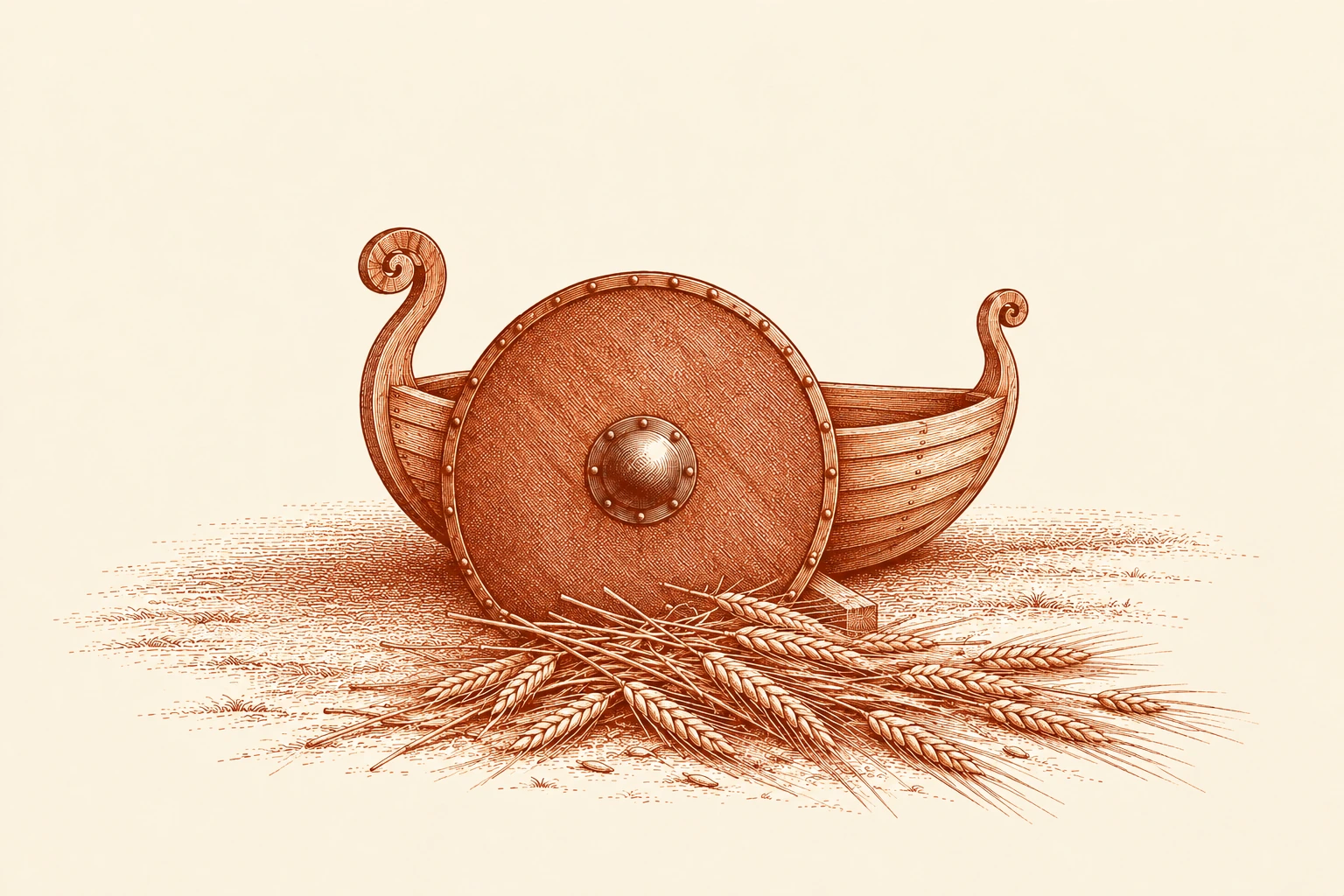
The child who comes over the water bears the promise of a king before he possesses a kingdom. He arrives from beyond the knowledge of the people who receive him; his beginnings are hidden, but the consequences of his coming become visible in the life of the land. He grows into the ruler who gives protection, establishes dominion, and leaves a royal inheritance. In the traditions surrounding Sceaf and Scyld, this movement from the unknown to the founding of a people is accompanied by objects whose ordinary uses disclose the character of the king. The sheaf feeds, the shield guards, and the ship carries the king and his power across the sea.
We propose that Sceafa is the original figure of this story, and that the scyld, the shield, first belongs to him as the conveyance of the arriving child. What bears and protects him in infancy becomes an emblem of the protection he will give as king. The sceaf, the sheaf, expresses the abundance associated with his coming, while the scip, the ship, enables him to establish and maintain his authority among peoples divided by water. These three alliterating words gather together the means by which a king sustains a realm. Read beside the Scandinavian traditions of Freyr and Fróði, they also permit a theological suggestion: the arriving Sceafa may be understood as Ing, appearing in the form of the founder whose gifts make kingship possible.
This is a theological reading of an inherited body of stories. We will gather the accounts in Æthelweard’s Chronicon, William of Malmesbury’s Gesta regum anglorum, and Beowulf, together with related legends, into a composite narrative. Their differences remain part of the evidence; the child upon the shield and the priority assigned to Sceafa are proposals within our reconstruction. The purpose of bringing the accounts together is to consider what their recurring images disclose about the god, the king, and the community that receives them. The studies of Robert P. Creed, Mercedes Salvador Bello, and Thomas D. Hill provide the principal scholarly foundation for this reading, although the synthesis and the identification with Ing are our own.1
The king who comes over the water
The sea is fundamental to the world in which these traditions belong. A people living among coasts, estuaries, and islands encounters the water as a route to other communities as well as a limit to its immediate territory. The figure arriving over the sea therefore comes from beyond the familiar without necessarily coming from beyond the imaginable. His arrival can establish a new relationship between the receiving people and the wider world; when that figure becomes king, the relationship becomes part of the people’s account of its own beginning.
Salvador Bello places Scyld and Sceaf beside the founding traditions of Hengest and Horsa, and Cerdic and Cynric. The circumstances differ, but the arrival from overseas repeatedly stands near the beginning of a dynasty’s account of itself. The crossing gives the founder a distinctive position within the story: he enters the country from elsewhere and becomes the point from which royal descent is reckoned. Such narratives belong to the cultural inheritance of communities for whom the sea brought ancestors, rulers, and new political relationships.2
The English tradition of Sceafa belongs within the North Sea and Baltic world of the Angles’ continental ancestors. Bede places their homeland, Old Anglia, between the lands of the Jutes and Saxons; the crossing to Britain forms part of the English account of their own beginnings. The royal stories preserved in England also look back across those waters. Æthelweard brings Sceafa to Scani, while Beowulf places Scyld at the head of Danish kingship. These stories preserve an ancestral world in which the sea joins the English to the peoples and traditions of their former homeland and its neighboring shores.
The names associated with Ing give further support to this setting. Sandred identifies the continental Angles with the Ingaevonic peoples and follows Krause in relating Beowulf’s Ingwina, “of Ing’s friends,” to an older name for that group. This proposed continuity adds to the evidence for a shared ancestral inheritance; within that inheritance, the arriving founder and the gifts accompanying him bring us to the religious character of kingship.3
Within this setting, the reception of the child deserves attention. He cannot claim authority through an already established local following, and his arrival does not begin with the defeat of the people who find him. They receive and nurture him. Hill’s observation that “true kingship is given, not won” concerns this founding relationship and the legitimacy that follows from it. The king is first accepted among his own people; his later power over neighboring peoples belongs to the exercise and extension of that kingship. This distinction allows us to hold together the helpless foundling and the formidable ruler without dissolving either into the other.4
Sceafa and the shield
Æthelweard tells of Scef arriving as a young child in a light vessel, with weapons around him, at an island called Scani. The inhabitants do not know who he is; they receive him, raise him, and eventually choose him as king. William of Malmesbury gives the arriving child the name Sceaf and describes him asleep with a sheaf of grain at his head. The unattended vessel and the extraordinary child call forth wonder, and the child’s subsequent rule gives meaning to his arrival. Beowulf places Scyld Scefing at the head of the Danish royal story, recalls his original destitution, and later compares the treasures at his departure with those given by the people who first sent him out over the water.5
The name Sceafa belongs naturally to the figure accompanied by the sheaf. In making him the original arrival, we take the agricultural sign as central to his identity and understand the shield as an object whose protective meaning could subsequently be embodied in the name Scyld. The interpretation of Scefing does not by itself settle the relationship. The ending can express association or descent more broadly than immediate fatherhood, and the surviving traditions arrange their ancestral figures in differing ways. Our reconstruction therefore rests on the coherence of the sheaf-bearing founder and his gifts; it does not depend upon extracting a single unambiguous family tree from the names.6
A related legend supplies an especially suggestive conjunction of the objects. In the account of the boundaries of Abingdon, a sheaf is placed upon a shield with a lighted candle, and the shield is set afloat. Its movement identifies the land belonging to the monastery. There is no child in this account, but the shield and sheaf travel together over water in an act that establishes a claim to territory. The correspondence matters because the floating objects do more than survive a journey. Their passage makes a relationship to land visible and authoritative.7
The possibility that the arriving hero was once carried on a shield has a place in older scholarship. In 1853, Wilhelm Wackernagel asked whether an earlier form of the story had given the hero a shield in place of a ship. Karl Simrock took up the suggestion in 1859, drawing upon the Norse description of the shield as Ullr’s ship. Both approached the shield voyage as a reconstruction of an earlier narrative; their conjecture gives a precedent for the image we adopt here.8
We bring this conjecture together with the Abingdon legend in the image of Sceafa borne upon the shield with the sheaf. The child brings abundance in a form that must itself be protected; the shield preserves the bearer of the coming harvest before he is old enough to preserve anyone else. As he grows into kingship, the relationship is enlarged. The protection first given to the child becomes the protection he extends to his people, and the grain beside him becomes the abundance expected under his rule. The objects acquire their royal significance through the life of the figure who bears them.
Creed’s treatment of the opening of Beowulf helps explain the force of this pairing. His proposed ancient maxim, “Sheaves beget scathers and need shields,” joins the production of wealth to the danger that attends its possession. A harvested field and a full storehouse give a community something to live upon and something to lose. The shield is therefore closely related to the sheaf: its work is to preserve the conditions under which abundance can be gathered and enjoyed. We need not adopt Creed’s proposed prehistoric dating of the formula to recognize the relationship he identifies between cultivated wealth and the duty to defend it.9
This is the first sense in which the objects become the symbolic regalia of Sceafa’s kingship. The sheaf expresses the plenty associated with the king’s presence, and the shield expresses his responsibility for its continuance. In the theological reconstruction, the shield has already performed that office at the beginning of his life. The same image can consequently carry the memory of his arrival and the meaning of his mature authority. What once sheltered the king now signifies the shelter afforded by his rule.
The shield and the raising of the king
The shield also belongs to the public establishment of royal authority. Among the Franks, Gregory of Tours records the elevation of Clovis and Sigibert upon shields when they were accepted as kings by those acclaiming them; he describes Gundovald’s elevation at Brive in the same material terms. The object that protects the warrior could also bear the ruler at the moment when his kingship was publicly acknowledged. Shield-raising thus has an attested place among Germanic royal installation practices.10
Within our theological reading, this action gives the shield a further significance. The king is lifted by the men who acknowledge his authority; their support becomes visible in the bearing of his body. The implement through which they defend themselves carries the person under whose rule their collective protection will be ordered. We may read the elevation as an enactment of mutual obligation: the king is borne by those whom he is expected to preserve, and his authority takes form within that relationship.
This deepens the image of Sceafa borne upon the shield. In our reconstruction, the shield first carries the child whose coming promises abundance; the historical rite allows us to place beside that arrival the raising of the mature ruler. Reception and elevation become corresponding moments in the life of the king. The people sustain the vulnerable arrival, acknowledge his authority, and look to him for the protection under which their own lives and harvests may flourish.
The shield consequently joins the sheaf and ship with a fuller royal office. It preserves the bearer of abundance, carries the acknowledged ruler, and expresses the protection expected of his rule; the ship gives that rule its reach among the surrounding shores.
The ship and the establishment of the realm
The ship must be given its full place within this account. In Beowulf, Scyld’s life between arrival and departure is a life of growing power. He takes the seats of other peoples, terrifies their leaders, and becomes a ruler whom those across the whale-road must obey and pay tribute. The poem’s judgment that he was a good king follows this description of established dominion. His kingship includes the ability to reach beyond his immediate country and make his authority effective among surrounding peoples.11
The whale-road is essential to the political geography of these lines. If the peoples who owe obedience and tribute lie across the water, royal power must be capable of crossing it. The poem does not supply an account of Scyld’s fleet or describe his campaigns in detail; its account of his dominion nevertheless requires us to think about the maritime means through which such a dominion could be established and maintained. The ship gives the king and his following access to those shores. It makes possible the movement of men and equipment, the enforcement of obligations, and the return of tribute to the royal center.
Here the vessel bears directly upon the establishment of the king’s territory. A realm understood through allegiance and tribute can extend beyond the land immediately around the royal hall. The sea between its communities does not remove them from the king’s reach so long as he possesses the means to cross it. His authority must travel where his demands are made; the ship allows that authority to become a continuing relationship rather than an assertion that distant people can safely disregard. The vessel is consequently part of the practical constitution of his dominion.
This also clarifies the peace associated with Scyld’s power. He brings neighboring peoples under his authority and exacts tribute from them, establishing an order in which his own people possess a commanding place. We should allow the force of that account to remain visible. The security celebrated by the poem is achieved through the king’s capacity to overcome resistance and compel recognition. Within the proposed theological reading, his friðu includes the strength required to secure the community and sustain its relations with those beyond it. The shield expresses protection; the ship carries the force that can make that protection effective at a distance.
Trade and defense further develop the ship’s place in this royal economy. These are implications of its function, rather than additional episodes reported in Scyld’s biography. A vessel can bring provisions, carry the surplus of a prosperous country into exchange, and maintain contact with other shores. It can also carry defenders toward a threat and preserve access to waters on which the community depends. For a coastal kingdom, the well-being represented by the sheaf is partly sustained by such movements. The sea offers resources and relationships that the king must be able to reach, as well as dangers against which he must be able to act.
The ship thus belongs throughout the life of the ruler. It brings the founder to the people, makes possible the extension of his authority, and eventually carries him away. Its presence at his funeral gathers the significance it has acquired through all these uses. The vessel that bears the dead king is already associated with the arrival of royal promise and with the reach of royal power. To understand its final journey, we must remember the living kingship that the ship has enabled.
Freyr and the peace of Fróði
The Scandinavian relationship between Freyr, Fróði, and prosperous kingship gives this reading a more explicit religious foundation. In Ynglinga saga, Freyr succeeds to rule, receives tribute, and is associated with fruitful seasons. The narrative places the beginning of Fróði’s peace within his days and says that the Swedes attributed the good seasons to him. Their wealth grows through peace and abundance. The same account gives Freyr the other name Yngvi, placing the connection between the god and the royal inheritance within the narrative itself. The following chapter brings Freyr’s son Fjölnir into friendly relations with Friðfróði at Lejre.12
These connections form a Freyr–Fróði complex of royal tradition in which the fruitful year and peace belong together. They do not require every figure called Fróði to be treated as the same historical king, nor do they make Freyr and Fróði interchangeable in every story. Their importance here lies in the explicit association of divine favor, royal rule, and the conditions under which a people prospers. The king’s relation to the god bears upon the life of the country; abundance and peace give that relationship a visible expression.
The formula ár ok friðr names these blessings. Ár in this setting carries the sense of a fruitful year, a good season, or the abundance produced by it; friðr names peace. Snorri’s account of Freyr in Gylfaginning makes the religious connection plain: Freyr governs rain, sunshine, and the produce of the earth, and he is invoked for fruitful seasons and peace. The formula describes benefits sought from the god and experienced in the material and social life of the people.13
Royal participation in securing these blessings is also explicit in Hákonar saga góða. Its account of the sacrificial feast associates the cup of Óðinn with victory and the king’s dominion, followed by the cups of Njǫrðr and Freyr for good seasons and peace. Elsewhere the farmers’ demand that Hákon sacrifice for those blessings makes the king’s religious duty part of the dispute over his rule. The different divine recipients belong to the same communal occasion, showing how the welfare of the realm draws upon relationships with more than one god.14
This gives the sheaf and shield a definite place in our interpretation. The prosperity signified by Sceafa’s sheaf corresponds to the fruitful year sought from Freyr; the protection signified by the shield corresponds to the peace expected within a flourishing kingdom. The ship supplies the means by which these conditions can be sustained in a world of separated shores. It carries the king’s power outward and brings people, provisions, and wealth into relationship with his realm. The three objects can therefore be read together as the equipment of a kingship whose blessings are named in ár ok friðr.
The blessing of the king
Hill’s comparison with the Anglo-Saxon coronation rite becomes particularly valuable at this point. He relates the protection of the shield to pax and the prosperity of the sheaf to abundantia, drawing attention to the prayer for pax et habundantia salutis. In the order printed by J. Wickham Legg from Corpus Christi College, Cambridge, MS 44, this phrase occurs in an antiphon following the giving of the ring. The preceding charge connects the ring with the strength of the kingdom, the increase of royal power, and the repelling of enemies. The requested blessing extends to the peoples of the Anglo-Saxon nation.15
The comparison with ár ok friðr is close. Abundantia corresponds to the plenty of a fruitful year, while pax, read together with the welfare expressed by salutis, corresponds to the fuller sense of friðu. The underlying noun salus includes health, safety, preservation, and well-being; these meanings give substance to the peace sought for the people. Grønbech’s account of frith helps make the correspondence clear. He describes an active condition of mutual protection and support, within which the community’s luck and well-being flourish. Read in this light, the coronation blessing seeks abundance together with the secure and flourishing life in which it can be enjoyed; the sheaf and shield give visible form to those blessings of kingship.16
This correspondence helps us understand what it means to call the sheaf and shield regalia. Hill’s comparison does not document a coronation in which these two objects were handed to the king. It discloses a relationship between the benefits named in the ceremony and the benefits embodied in the legendary names. In our theological reading, the objects accompany Sceafa because they express the office he will fulfill. The shield of his childhood anticipates the peace of his kingship, and the sheaf anticipates the abundance associated with his presence. The ship completes the equipment of that office by giving its authority the reach required in a maritime world.
Recognizing Ing in the arriving king
The proposal that Sceafa may be understood as Ing now rests upon a connected set of relationships. The founder arrives among peoples whose traditions remember the sea as a route of royal beginnings. He is accompanied by the sign of agricultural abundance, protected by the object that will express his own protective office, and associated with the vessel through which his dominion can be established. Freyr, explicitly called Yngvi in the Scandinavian royal tradition, is a god from whom fruitful seasons and peace are sought. The correspondence concerns the character and activity of the figure as well as the objects around him.
The Ing stanza of the Old English Rune Poem provides another part of this setting. Ing is remembered among the East Danes and then departs over the waves. The stanza associates Ing with the Danish people and with movement over water. It does not describe an arriving infant or name a ship, but its remembered god belongs within the same broad world of divine presence and maritime departure. Set beside the other traditions, it makes the suggestion of Ing more closely fitted to the evidence than an identification based upon agricultural symbolism alone.17
Freyr’s ship, Skíðblaðnir, gives the vessel an especially direct place in this comparison. Grímnismál names it as a ship made by the sons of Ívaldi for Freyr. In Gylfaginning, it can carry all the Æsir with their weapons and war gear; it receives a favorable wind when its sail is raised and can be folded together when it is not needed. Its capacities join extraordinary mobility to the ability to carry an armed company. This is a divine possession well suited to the wider conception of royal reach developed here, even though the passage does not narrate a campaign of conquest by Freyr.18
The linguistic pattern adds a further point of interest. Sceaf, scyld, and scip begin with the same Old English sound, allowing the three objects to be remembered together. The first element of Skíðblaðnir has a cognate in Old English scíd, a piece of split wood. An imagined Old English rendering of the ship’s name might therefore participate in the same initial pattern; a form such as scíd-blæd remains conjectural. The ship’s theological importance is already present in its ownership and capacities, and does not depend upon recovering an unattested Old English name.19
We may consequently suggest that Sceafa is Ing in the form of the arriving founder. The suggestion gives a divine identity to the relationship expressed by the sheaf, shield, and ship: the god whose presence is associated with abundance comes to the people, establishes the conditions of their flourishing, and becomes the source of a royal inheritance. This is an act of theological recognition within the transmitted stories. It does not require us to claim that every recorder understood the figure in this way, or that the surviving names preserve one uncontested account of his genealogy. The proposed identity gathers the evidence into a religious understanding of why these gifts belong together.
The inheritance of the departing king
Scyld’s departure in Beowulf returns him to the water in a vessel laden with treasure. The poet recalls his first sending as a child and leaves the destination of his final journey unknown. The people know what the king has become among them, although they cannot fully account for where he came from or who will receive him. Between those two journeys lies the establishment of a dynasty and a dominion. His departure completes a life whose consequences remain in the world he leaves behind.20
Read through Sceafa and Ing, that life becomes an account of how divine benefaction takes form in a community. The arriving child must be received and sustained; the king who grows from him must sustain the people in turn. The sheaf gives tangible form to abundance, the shield to the protection under which it can endure, and the ship to the reach through which the realm is established and maintained. Together they express an authority whose worth is measured in the continued life of the people.
The inheritance of the king is therefore carried by more than his descendants’ names. It lies also in the work that follows from receiving these gifts: the keeping of a fruitful land, the preservation of the community, and the ability to maintain its place among the peoples across the water. In the Freyr–Fróði traditions these blessings are joined in ár ok friðr. In the theological reading proposed here, Sceafa brings them over the sea as Ing, and the sheaf, shield, and ship disclose the character of the kingship that comes with him.
Principal studies
Creed, Robert P. “Is There an Ancient Gnome in Beowulf Line 4?” Folklore Forum 13, nos. 2–3 (1981): 109–126.
Hill, Thomas D. “Scyld Scefing and the ‘Stirps Regia’: Pagan Myth and Christian Kingship in Beowulf.” In Magister Regis: Studies in Honor of Robert Earl Kaske, edited by Arthur Groos and others, 37–47. New York: Fordham University Press, 1986.
Salvador Bello, Mercedes. “The Arrival of the Hero in a Ship: A Common Leitmotif in OE Regnal Tables and the Story of Scyld Scefing in Beowulf.” Selim 8 (1998): 201–216.
Footnotes
Creed, “Is There an Ancient Gnome,” pp. 109–126; Salvador Bello, “Arrival of the Hero,” pp. 201–216; Hill, “Scyld Scefing,” pp. 37–47. None of these studies establishes the identification with Ing. Sceaf, Scef, and Sceafa are retained where appropriate to the witness or to the proposed theological figure; scip is the singular “ship,” scipu a plural form.
Return to textSalvador Bello, “Arrival of the Hero,” especially pp. 202–211. Her comparison concerns the shaping of royal origins and genealogies; recurrence of a motif does not by itself establish a single fixed original narrative.
Return to textBede, Historia ecclesiastica gentis Anglorum I.15, on the continental homeland of the Angles; Æthelweard and Beowulf as cited in n. 5. Karl Inge Sandred, “Ingham in East Anglia: A New Interpretation,” Leeds Studies in English, n.s. 18 (1987): 231–240, at pp. 234–235, identifies the Angles with the Ingaevones and discusses Wolfgang Krause’s proposed reinterpretation of reconstructed *Ingwena as Ingwina, “of Ing’s friends” (Beowulf 1044, 1319). The asterisk marks an unattested reconstruction. Tacitus, Germania 2 and 40, discusses the Ingaevones and the Anglii separately; Pliny, Naturalis historia IV.99, names the Cimbri, Teutoni, and Chauci as part of the Ingvaeones. Their notices provide no complete membership list or fixed boundaries for this ancestral grouping.
Return to textHill, “Scyld Scefing,” pp. 37–40, quotation at p. 39. The distinction between the founder’s reception by his people and his subsequent dominion over neighbors is developed here from Hill’s argument and Beowulf’s opening.
Return to textÆthelweard, Chronicon, book III, ed. and trans. A. Campbell, The Chronicle of Æthelweard (London: Thomas Nelson, 1962), p. 33; William of Malmesbury, Gesta regum anglorum II.116, ed. William Stubbs, vol. 1 (London, 1887), p. 121; Beowulf, lines 4–11, 43–46. The chronicle passages are reproduced and discussed in Hill, pp. 38–39 and n. 7, and Salvador Bello, pp. 209–211.
Return to textCreed, “Is There an Ancient Gnome,” p. 111; Hill, “Scyld Scefing,” p. 40. The proposed priority of Sceafa and the development of the shield into a named figure are our reconstruction. Hill’s argument does not establish that sequence.
Return to textChronicon monasterii de Abingdon, ed. Joseph Stevenson, vol. 1 (London, 1858), pp. 88–89; discussed by Hill, “Scyld Scefing,” p. 40 n. 8, with reference to R. W. Chambers, Beowulf: An Introduction, pp. 83–84. The Abingdon account contains the shield, sheaf, and candle, but no child. It supplies the conjunction of the objects and the claim to land; the child belongs to the broader synthesis.
Return to textWilhelm Wackernagel, “Gewerbe, Handel und Schifffahrt der Germanen” (1853), reprinted in Kleinere Schriften, vol. 1 (Leipzig: S. Hirzel, 1872), p. 81, continuation of n. 9; Karl Simrock, Beowulf (1859), commentary §5, “Beaw und Heremod.” Wackernagel asks whether the hero originally arrived on a shield; Simrock repeats the conjecture and compares Ullr’s shield–ship association. Neither passage cites a surviving medieval account explicitly placing the child on a shield. For a modern comparison of a conjectured shield voyage of Ullr with Scyld Scefing, see Snorri Sturluson, Heimskringla, vol. 1, trans. Alison Finlay and Anthony Faulkes, 2nd ed. (London: Viking Society for Northern Research, 2016), p. 122 n. 302.
Return to textCreed, “Is There an Ancient Gnome,” pp. 116–121, quotation at p. 119. Creed’s proposed sequence is sheaf, scather, and shield. The present paper brings the ship into a different, royal and maritime, synthesis.
Return to textGregory of Tours, Histories II.40 (Clovis) and IV.51 (Sigibert), and VII.10 (Gundovald). For the earlier elevation of Brinno as a war leader, see Tacitus, Histories IV.15.
Return to textBeowulf, lines 4–11, especially ofer hronrade hyran scolde, / gomban gyldan, “across the whale-road had to obey, to pay tribute.” Translation here is our own. Ships as the practical means of this reach, and the further discussion of trade and defense, are interpretive developments rather than additional narrated deeds of Scyld.
Return to textSnorri Sturluson, Ynglinga saga, chapters 10–11, in Heimskringla, ed. Finnur Jónsson (1900). Chapter 10 also recounts the continuation of tribute and prosperity after Freyr’s death and the subsequent honoring of him for fruitful seasons and peace. References follow the chapter divisions of this edition.
Return to textSnorri Sturluson, Gylfaginning, chapter 24. Ár ok friðr gives the nominative form of the paired expression; til árs ok friðar is its form after til, “for good seasons and peace.” The spelling of the Old English term friðu is retained in discussion of the proposed Anglo-Saxon theological reading.
Return to textSnorri Sturluson, Hákonar saga góða, chapters 14 and 16, in Heimskringla, ed. Finnur Jónsson: respectively the sacrificial feast and the farmers’ demand that the king sacrifice. Chapter numbering differs in other editions. The formula is associated with Njǫrðr as well as Freyr in the feast account.
Return to textHill, “Scyld Scefing,” p. 41 and n. 9; J. Wickham Legg, ed., Three Coronation Orders, Henry Bradshaw Society 19 (London, 1900), p. 56, “Consecratio regis Anglo-Saxonici,” from Cambridge, Corpus Christi College, MS 44. The antiphon follows the ring; the comparison with sheaf and shield is symbolic.
Return to textVilhelm Grønbech, The Culture of the Teutons, trans. W. Worster (1931), vol. I, chapters 1, “Frith,” and 4, “Luck”; Charlton T. Lewis and Charles Short, A Latin Dictionary (Oxford: Clarendon Press, 1879), s.v. “salus.” Salutis is the genitive of salus, qualifying abundantia in the Latin phrase; the comparison brings its sense of welfare together with pax to express the broader meaning of friðu.
Return to textOld English Rune Poem, Ing stanza, in Bruce Dickins, ed. and trans., Runic and Heroic Poems of the Old Teutonic Peoples (Cambridge: Cambridge University Press, 1915).
Return to textGrímnismál, stanzas 43–44; Snorri Sturluson, Gylfaginning, chapter 43. The latter explicitly includes the Æsir’s weapons and war gear among what Skíðblaðnir can carry. This supports the comparison of capacities; it does not establish that Sceafa’s vessel and Skíðblaðnir were historically a single named ship.
Return to textBosworth–Toller, An Anglo-Saxon Dictionary, s.v. “scíd.” The proposed scíd-blæd is an imaginative anglicization, not an attested Old English name or a demonstrated reconstruction of the entire Norse compound. The alliteration of sceaf, scyld, and scip is independent of that suggestion.
Return to textBeowulf, lines 26–52, with the comparison to the first voyage at lines 43–46; Hill, “Scyld Scefing,” pp. 39–40, on the founder’s departure and legitimate succession.
Return to text