Lore of the Hwítmerscingas
Where the Reeds Part
Eorxnawang and the Crossing of the Dead
The understanding set out here belongs specifically to Hwítmersc Cynn, known in English as Whitemarsh; it forms part of our cynn’s theology of death and the afterlife. Hwítmersc belongs to Fyrnsegen, but this account is not a statement of doctrine for Fyrnsegen as a whole, nor does it bind its other cynn to the same understanding. We speak here for our own community, from the landscape through which we understand our place in the world.
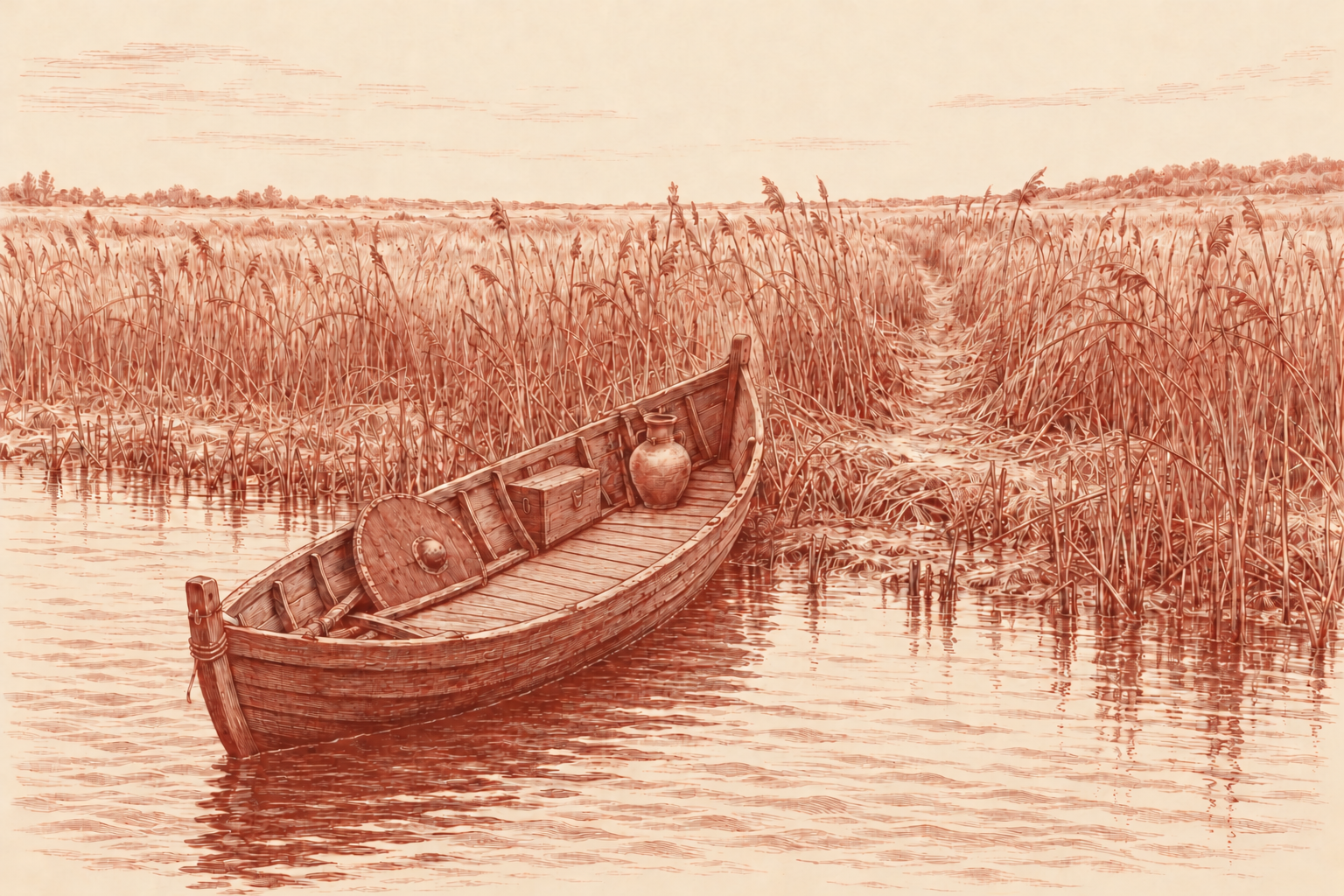
Our account begins with Eorxnawang and the image of a ship standing within a field. The ship expresses departure and crossing; the field gives that passage a place of arrival. Between the inhabited world and the country beyond lies water, approached through reeds on either shore. When these images are brought together, death can be understood as a passage out of the country of the living into a country in which the dead have their dwelling; the burial place gives that passage a visible form among those who remain.
For Hwítmersc, the marsh belongs to this understanding from the beginning. Land meets water through a margin in which each enters the other; reeds rise where firm ground gives way, and where ground begins to gather again. We take this familiar landscape into our theology because it allows us to speak of separation without losing the relationship between the two shores. The dead depart from the world we inhabit; our obligations to them continue on this side of the water.
The construction of Eorxnawang
Eorxnawang names for us the Field of Rushes, the reedy country approached beyond the crossing. In surviving Old English texts, the familiar form Neorxnawang serves as a native equivalent of Latin paradisus; the final element, wang, means field, meadow, land, or country.1 The first element has long invited competing explanations. We propose a construction connecting it with the vocabulary of water-rushes, bringing the resulting name into relation with the sacred fields and watery thresholds through which we understand the passage of the dead.
The botanical starting point is the attested water-rush vocabulary represented by eá-risc and eá-rixe. A remedy preserved in Leechdoms III contains the words “Nim þanne earixena wyrtruman,” meaning “Take then the roots of water-rushes.” Here earixena supplies the genitive plural, “of water-rushes”; it gives the construction a linguistic point of departure in an actual plant-name and its inflection.2
Bosworth–Toller also records eó-risc, “a bulrush,” and refers the reader directly to eá-risc. This places an eo- form beside ea- within the vocabulary of water-rushes; it gives our reading of eorxena a recorded botanical parallel, while the contraction of the fuller form remains part of the reconstruction proposed here.3
From the fuller genitive earixena, our reconstruction proposes the reduction of unstressed medial vowels, a process called syncope, to produce a contracted element of the shape earxna. We place eorxna and eorxena within this same water-rush construction, drawing on the eo- form recorded in eó-risc; these connections allow the apparently opaque first part of the name to be approached through the plants of the water’s edge.
The initial n of Neorxnawang is then explained through a change in the perceived boundary between words. In a phrase such as on eorxena wange, “in the field of rushes,” the final n of on could have been heard as belonging to the following name and subsequently retained as its opening consonant. This is junctural reanalysis: a sound is reassigned across a word boundary, and the reassigned form becomes established. On this account, Neorxnawang preserves a reshaping of Eorxnawang; the n need not belong to the original botanical element.4
The construction therefore proceeds from a genitive plural referring to water-rushes, through contraction and reassignment of the initial n, to a compound whose final element supplies the field itself. Eorxena and wang together yield the reading “Field of Rushes.” This is the reading we adopt within Hwítmersc; the name identifies a landscape whose vegetation and position at the water’s edge are essential to its religious meaning.
The field element also places the construction beside a wider Germanic vocabulary of sacred country. Old Norse Fólkvangr gives an afterlife setting to Freyja’s reception of the slain; himinvangar names the fields of heaven or sky, while Old Saxon hebanwang supplies a corresponding heavenly field. Hopkins and Þorgeirsson draw these forms into comparison with Old English Neorxnawang.5 Their conjunction suggests that the field could carry sacral and afterlife associations at an early stage; within our construction, wang gives those associations the spatial character of a country in which one can arrive and dwell.
The reeds give that country its threshold. Rushes and sedges grow where water and land meet; rooted in the ground while rising through or beside the water, they hold together the conditions between which passage takes place. Their fertility and their place at the margin allow the Field of Rushes to be understood as a landscape of sacred approach. Its vegetation marks the change from one country to another, and from one manner of existence to another.
This also belongs to Hwítmersc’s reading of the emergence of Sceafa and Ing. In our rendering of gesewen secgum as “seen among the reeds,” the reeds locate the manifestation at a threshold; the figure becomes present where water gives way to inhabited land. The same landscape can therefore express both divine emergence and the passage of the dead. What arrives from beyond the water enters through the margin at which another traveller may depart.
A wider comparison is supplied by the Egyptian Field of Reeds, Sekhet-Iaru, where the blessed dead inhabit a fertile landscape of waterways and fields.6 Latin campi cyperorum, “fields of sedge,” gives us corresponding descriptive language for such a landscape. The comparison brings the reed-field into a broader religious setting in which water, abundant growth, and the dwelling of the dead belong together; Hwítmersc develops its own account through the Old English construction and the marsh through which we understand it.
The resulting geography extends from the world of the living through a reedy margin, across the sea, and through the reeds of the farther shore into the country of the dead. The rushes occur on both sides of the crossing; each shore opens upon the water, and each can be approached from it. Eorxnawang consequently holds together a dwelling-place of the blessed dead and a threshold of passage. We understand its stillness as the stillness of a country reached, while its reedy margin remains open to arrival and emergence; the same threshold can be understood as admitting souls into life as well as receiving them in death.
A field gives the journey somewhere to end. Once we speak of the dead as having crossed, we must also be able to speak of their arrival; Eorxnawang supplies the landfall which completes this passage. Beyond the rushes there is ground upon which the traveller can go onward, and a country in which the dead can belong. This construction of the name and its landscape is the foundation upon which the ship in the field takes its meaning.
The reedy threshold
The inhabited world is the world in which we can still answer one another directly. It contains our households and work, our promises and the ordinary acts by which people become known to one another. Death removes a person from that immediate exchange; a familiar voice is absent, a place at the table is empty, and responsibilities must be taken up by other hands. The near shore begins within these particular losses.
As we approach the water, the reeds mark a change in the character of the ground. What supported the journey on foot no longer supports it in the same way; passage must take another form. The marsh thus gives us a threshold with depth. One comes into it from the inhabited country, moves through its uncertain footing, and reaches the water from which departure becomes possible.
The reeds belong equally to the farther shore. Seen from land, they mark the approach to water; seen from a vessel, they announce the approach to land. Their meaning changes with the direction of travel, while their place between the two remains the same. This is why they can join the living country to Eorxnawang without collapsing the distinction between them: what is left behind at departure is encountered again as the sign of arrival.
For Whitemarsh, this relation between land and water gives local form to the passage of the dead. Our name and our landscape provide a language through which the crossing can be contemplated and represented. We do not need to place the farther country upon a chart of the Chesapeake; the marsh we know teaches us how one kind of country can open upon another, and how a shore can be both an ending and an approach.
Departure and crossing
The ship belongs to the passage because it bears a person where the ground of ordinary life no longer carries them. Within this account, its theological work is movement across separation. The water has an extent which must be traversed; the vessel gives the dead a means of reaching the country beyond it.
Departure is therefore a change in the manner of belonging. The dead no longer participate in the household as they did while living, yet the life which has ended remains part of the household’s history. Deeds continue in their consequences, promises may leave work unfinished, and the living inherit things they must either uphold or answer for. The crossing takes a person beyond our daily company; it leaves us with the obligations which their life has placed among us.
Water makes the separation real. A crossing cannot be reduced to stepping into the next room, and grief cannot be resolved by speaking as though nothing has altered. At the same time, water is traversable; it allows us to conceive of distance together with a relation between shores. The ship holds both understandings within a single image, carrying the reality of departure toward the possibility of arrival.
This is the movement expressed by our account: from the inhabited country, through its reedy margin, across the water, and through the reeds of the farther shore into Eorxnawang. Each part belongs to the meaning of the whole. The near shore gives the departure its human setting; the farther shore gives the journey its completion.
The ship within the field
The conjunction of ship and field also has a suggestive historical parallel. In The Ship in the Field, Joseph S. Hopkins and Haukur Þorgeirsson consider the name Sessrúmnir, which occurs as Freyja’s hall in one source and among ship names in another. They propose that these notices might preserve complementary aspects of an afterlife location in Fólkvangr; a ship within a field would also recall the stone ship settings associated with Scandinavian burial sites.7
Their proposal supplies a point of comparison for our theology. Hwítmersc develops the conjunction through the relation between passage and dwelling; we understand the ship and the field as successive aspects of the dead person’s journey which can be present together in one image. This reading is our theological development of the material, rather than a claim that the surviving sources set out this same sequence.
A ship standing in a field brings movement into the place of arrival. Its form recalls the water it has crossed, even while the ground beneath it announces that the crossing has reached another shore. The vessel retains the meaning of departure within a place of dwelling; the field receives that meaning and gives it a destination.
The image can consequently be read from either side of the passage. Those who remain see the vessel in which the dead depart; the field permits them also to envision the ground upon which the dead have arrived. What occurs successively in the journey is held together in the burial image. Departure and arrival become two aspects of the same passage, available to contemplation in a single place.
The burial place
The burial place belongs physically to this country; it is ground which the living can approach, tend, and revisit. Within our theology it can also bear the image of the farther country. A ship set within a field brings the crossing and its completion into the landscape of the living, establishing a place at which the dead can be remembered and addressed as those who have gone beyond it.
This double relation helps us understand how the dead may have departed while their grave remains a place of approach. The body has been entrusted to the earth here; the person is understood through the passage into the country beyond. The grave holds these relations together for the living, giving the name and the crossing a particular place within the land they continue to inhabit.
A community can give material form to this understanding through the arrangement of a memorial or burial place, and through the images it uses when speaking of its dead. The form belongs to the meaning it carries. A representation of the ship, the reedy shore, or the field can recall the whole passage; the account does not depend upon every burial reproducing a complete landscape.
The living shore
For those who remain, the crossing alters the relationship without abolishing what the relationship requires. We must learn to address the dead from the living shore. Remembrance, care for the burial place, and the keeping of names give that relationship expression; the consequences of the dead person’s deeds continue to require judgement and action in our own lives.
To remember someone truthfully is to preserve the particular person within the life of the community. Death does not make every deed worthy of praise, nor does affection discharge every obligation left behind. The dead retain their histories among us; what we inherit from them must still be understood, and what we pass onward becomes part of our own responsibility.
Eorxnawang gives this continuing relationship a farther term. The dead are understood to have their dwelling beyond the crossing; remembrance takes place in relation to those who have gone there. Their country is their own, while our duties are performed here. Tending a grave, telling a life truthfully, or carrying an obligation forward gives the living something definite to do with a bond which death has changed.
Within Hwítmersc, the ship and the field therefore belong together. The ship carries the departure from the inhabited world; the field gives the passage a country of arrival, and the reeds mark the approach to water on one shore and the approach to land on the other. Brought into the burial place, these images allow us to acknowledge both the absence of the dead from our daily company and their dwelling beyond the crossing. This is Whitemarsh’s account of that passage, held and developed within our own cynn; other cynn of Fyrnsegen speak from their own understanding, and this paper makes no claim to speak for them.
Notes
Bosworth–Toller, An Anglo-Saxon Dictionary Online, s.vv. “neorxna wang” and “wang”: https://bosworthtoller.com/23570 and https://bosworthtoller.com/34644.
Return to textLeechdoms, Wortcunning, and Starcraft of Early England, vol. III, p. 122, line 8; cited under “eá-rixe” in Bosworth–Toller. The fuller phrase is also transcribed in the Helsinki Corpus, Peri Didaxeon. Jane Roberts discusses earixena and the possible presence of rush vocabulary in Neorxnawang in “A Preliminary ‘Heaven’ Index for Old English,” Leeds Studies in English, n.s. 16 (1985), pp. 208–219, at 215–216; her complete derivation differs from the one adopted here.
Return to textBosworth–Toller, An Anglo-Saxon Dictionary Online, s.vv. “eó-risc” and “eá-risc”: https://bosworthtoller.com/9519 and https://bosworthtoller.com/8651. The eó-risc entry defines the word as “a bulrush; scirpus” and cross-refers to eá-risc; the latter is defined as “a water-rush, bulrush.” The entries support the botanical relationship discussed here; the proposed contraction into eorxna or eorxena remains our reconstruction.
Return to textThe contraction and word-boundary explanation develop the construction in On Eorxnawang, pp. 1–2. They are presented here as the derivation proposed within that account, with the attested water-rush forms distinguished from the reconstructed stages.
Return to textJoseph S. Hopkins and Haukur Þorgeirsson, “The Ship in the Field,” RMN Newsletter 3 (2011), pp. 14–18, at p. 15, on Fólkvangr, himinvangar, hebanwang, and Neorxnawang.
Return to textThe Metropolitan Museum of Art, “Field of Iaru,” in its presentation of Egyptian funerary facsimiles, p. 10, describing the scene from the tomb of Sennedjem. Campi cyperorum is used here as a Latin description of sedge-fields, rather than attributed to a particular ancient glossary.
Return to textHopkins and Þorgeirsson, “The Ship in the Field,” pp. 15–16. The authors offer the reconciliation of Sessrúmnir as hall and ship as a possibility; they also acknowledge that one use of the name might reflect a misunderstanding.
Return to text