Lore of the Hwítmerscingas
The Unwinding of Ragnarök
Cyclical Myth and the Making of an End
The World Without an End
The natural world knows destruction, but it does not know finality in the sense demanded by eschatological religion. The sun rises and sets, the seasons succeed one another, and the living world passes through generation, maturity, decline, and death; what perishes returns to the earth, providing the substance from which new life emerges. These processes do not bring existence toward some appointed conclusion, nor do they require a final resolution in order to possess meaning. Their continuance is itself the order of things.
It is within this understanding of existence that we ought to consider the inherited myths of the Germanic peoples. The gods participate in a world governed by recurring conditions, and their deeds give expression to relationships as enduring as the processes of nature itself. Life must continually be defended against destruction; the dead must be received and conducted beyond the condition of the living; the inhabited world must be maintained against those powers which threaten its boundaries. The myths disclose something of the gods' natures, not simply by recounting deeds performed in some distant past, but by revealing the conditions under which the world is constituted and maintained.
A religious understanding organized around such processes has no inherent need for an eschaton. The destruction of a world, the passing of a divine order, or the death of those who sustain it need not imply that existence itself must arrive at a final and irreversible conclusion. What has been constituted may be dissolved, and what has been dissolved may provide the conditions for something else to arise; the order continues through change rather than through the preservation of all that presently exists.
Yet the surviving accounts of Ragnarök present us with something remarkably different. The gods are gathered into a final confrontation with their adversaries, the existing world is overwhelmed, and the catastrophe is followed by the emergence of another world. Relationships that might otherwise be understood as enduring conditions of existence have been arranged into a sequence of events directed toward a particular conclusion. Their recurring character is obscured by a narrative structure that transforms the destruction of a world into the end of the world.
Hwítmersc rejects eschatology as a component of its theology. We do not understand the world as moving toward an appointed end, nor do we regard the destruction of the existing order as a necessary precondition for its ultimate fulfillment. Such a conception is foreign to our understanding of a world constituted through recurring processes of generation, dissolution, inheritance, and renewal; there is no final condition toward which these processes must advance, and no consummation that renders their continuance unnecessary.
This rejection does not oblige us to discard the inherited poems in which Ragnarök is presented as an eschatological event. The constituent myths remain recognizable, even where their relationships have been altered by the narrative into which they have been assembled; by considering the deeds of the gods according to their natures, rather than solely according to their places within a sequence of final events, we may recover the cyclical relationships obscured by their eschatological arrangement. Our purpose is not to reconstruct some lost poem, nor to establish precisely when or by whom the transformation occurred, but to recover the theological meaning of myths whose surviving forms have been made to serve a conception of existence that we do not share.
The Circle, the Spiral, and the Line
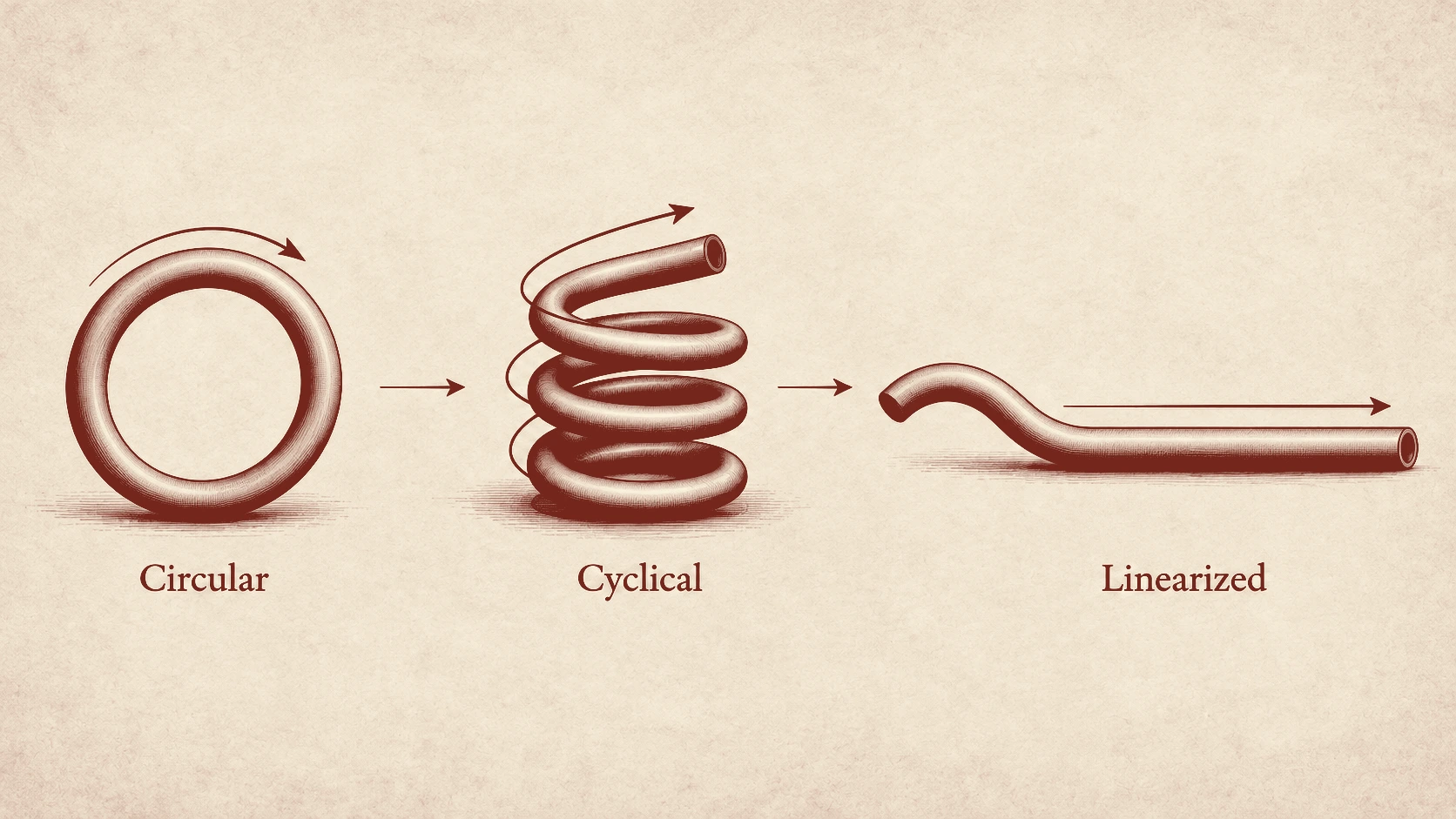
There is an important distinction between a circular process and a cyclical one, although the terms are frequently used interchangeably. A circle returns continuously to its beginning, repeating the same course without meaningful alteration; a cycle likewise exhibits recurrence, but its successive turns need not be identical. What returns is a recognizable relationship or condition, not necessarily the same participants or circumstances.
The agricultural year illustrates this distinction particularly well. Each spring brings renewed growth, but the grain that rises is not the same grain that stood in the field the year before. The harvest destroys the standing crop while preserving within its yield the means by which another may arise; the next generation inherits the substance and consequences of what preceded it, and in turn provides for what will follow. The process recurs, but recurrence is accompanied by change.
We might therefore represent cyclical existence as a spiral rather than a closed circle. Each turn resembles those that preceded it while occupying a different position; the cycle continues without returning precisely to its beginning, and its continuity resides not in the preservation of every constituent part, but in the relationships through which successive generations arise. The world is neither static nor condemned to repeat itself without alteration. It possesses a history, but that history is not directed toward a final destination.
Eschatology imposes a different understanding of time. Events are arranged along a line extending from an original beginning toward an ultimate conclusion, and their significance increasingly depends upon their place within that progression. Creation becomes the opening of a history that must eventually close; destruction becomes the means by which that closure is accomplished, while renewal establishes a final condition rather than another turn of the cycle. What had been understood as the ordinary processes of existence becomes provisional, awaiting a consummation through which those processes will be brought to an end.
The transformation can be imagined as the unwinding of a spiral. Its successive turns are drawn out and laid along a line, leaving their constituent parts recognizable while changing their relationship to one another. Recurrence becomes succession, and an enduring condition becomes an event assigned to a particular moment in time; the character of the individual stories may remain largely intact, even as the larger structure through which they are understood alters their meaning.
We believe that something of this nature has occurred in the accounts gathered under the name Ragnarök.
Ing Fréa and the Preservation of Life
Ing Fréa's confrontation with Sweart is ordinarily treated as one of the tragedies of Ragnarök.1 Having relinquished his sword, he faces the destructive power that will consume the world, and in the ensuing confrontation he falls. Understood as an episode in an eschatological narrative, his death contributes to the destruction of the existing divine order; understood through the nature of Ing Fréa himself, however, the encounter reveals something altogether different.
Ing Fréa is the god of fertility, agriculture, and the generation of life; the increase of the fields, the fruitfulness of livestock, and the prosperity of the household belong to the abundance through which his beneficence is made manifest. His concern is not simply with the appearance of life, but with its continuance through successive generations, each receiving what has been preserved by those who came before. The seed entrusted to the earth, the grain gathered at harvest, and the offspring that replenish the herd all participate in this work; they are expressions of the capacity of living things to reproduce themselves, even as the individuals through which that capacity is realized inevitably perish.
Agriculture makes the cyclical nature of this relationship particularly apparent. The farmer does not preserve the standing crop indefinitely, for the grain must be cut if its abundance is to be gathered, and a portion of that abundance must be returned to the earth if another harvest is to follow. The destruction of the crop is therefore not the defeat of agriculture, but an indispensable part of its continuation; what has been brought to maturity must surrender its present form so that its generative capacity may pass into another generation. Ing Fréa presides over this recurring passage from life through death into life again, and the prosperity that belongs to his nature is realized through the continuance of the process rather than through the permanence of any particular harvest.
It is in this light that his confrontation with Sweart becomes intelligible. Ing Fréa faces the annihilating fire unarmed, not because he has ceased to be the god of life, but because the preservation of life remains his concern even when the destruction of its present form cannot be prevented. He does not stand against Sweart with any assurance that the existing world can be saved; he stands against him because life must be carried through the catastrophe, just as the seed must be preserved through the death of the standing grain.
While Sweart's flames overwhelm the world, Líf and Lífþrasir remain concealed within Hoddmímir's wood, sustained by the morning dew until they emerge to replenish humankind.2 Ing Fréa confronts the destroying fire so that life may survive its passage; what is sheltered within the tree is the living seed of the world that follows, preserved against the destruction of the world in which it was conceived. The tree thus becomes a refuge of generative possibility, containing within itself the means by which the loss of the existing order may be answered through renewal.
A comparison with John Barleycorn is instructive, for the grain is cut down, beaten, and apparently destroyed, yet its destruction is inseparable from its regeneration. What falls beneath the sickle does not return as the same stalk, for the old growth has perished; nevertheless, its generative capacity persists in the seed from which another harvest will arise. The figure of John Barleycorn expresses this passage through personification, giving human form to the grain that must suffer destruction in order that its abundance may continue. Ing Fréa's confrontation with Sweart belongs to the same theological understanding of life, in which apparent defeat does not exhaust the power of generation, but provides the conditions under which another manifestation may arise.3
The distinction between cyclical and eschatological interpretations is therefore not a distinction between life and death, nor even between destruction and survival. Both understandings recognize that a world has been consumed and that life subsequently emerges; what separates them is the significance assigned to that emergence. Within the cycle, life returns because generation and dissolution belong to a continuing order, while in an eschatological narrative the preservation of life becomes an episode through which history advances toward its final condition. Ing Fréa's work, understood cyclically, is never exhausted by the destruction of a particular world, for the generative power that belongs to his nature remains necessary wherever life is to arise and prosper.
Wóden and the Devouring Grave
The confrontation between Wóden and Fenwulf expresses another relationship belonging to the continuing order of existence, although here the concern is not the generation of life but the selection, reception, and passage of the dead.4
Wóden is intimately associated with death, particularly with those who perish in battle; he is the receiver of the slain, the lord of the company into which they are gathered, and the divine authority under whom their passage from the living world is accomplished. In this capacity he may be understood as a psychopomp, comparable in function to Hermes, although his relationship with the dead includes something more particular than their conveyance from one condition to another. Wóden chooses those who shall fall, whether through his own intervention or through the agency of the wælcyrgan, whose very name identifies them as the choosers of the slain.5
The battlefield is therefore a place in which Wóden's authority becomes manifest. The wælcyrgan are not merely attendants who arrive after the fighting has ended to gather those already dead; their choosing belongs to the battle itself, determining who shall fall and who shall be received into the company of the slain. The warrior who enters combat exposes himself not only to the weapons of his enemies, but to a divine judgment concerning the disposition of his life. The choice of the slain is consequently inseparable from the conduct of warfare, and the dead who are gathered to Wóden are not simply those whom chance has removed from the living world.
This relationship is made particularly intelligible through the distinction between death and the grave. The battlefield produces the slain, but the disposition of the slain is not exhausted by the destruction of their bodies. Wóden receives them, and the wælcyrgan conduct those who have been chosen into another condition of existence; their work concerns not merely the moment at which life is lost, but the passage by which the dead are brought into the relationships that await them beyond it. Death is thus more than an event that terminates mortal activity, for the individual who has departed from the living world has not necessarily ceased to participate in the wider order of existence.
Fenwulf, understood as the devouring grave, represents the apparent finality against which this understanding of death must be considered. The wolf swallows its victims whole, enclosing them within itself and removing them from the sight of the living; the grave likewise receives the dead, concealing what it has taken and leaving those who survive to confront the seeming permanence of their loss. Where Wóden's work concerns the selection and conveyance of the departed, the wolf appears to make their departure absolute, consuming what it receives and allowing nothing to pass beyond its possession.
The symbolism of Sleipnir becomes particularly suggestive in this context. The eight-legged horse may be understood as an image of the funeral bier carried upon the eight legs of four pallbearers; Wóden thus rides toward the devouring grave upon a figure that expresses the conveyance of the dead.6 The procession by which the mortal body is borne to its resting place becomes, in the image of the god and his steed, a passage into the divine realm of death itself. Wóden does not stand apart from the condition through which mortals must pass, but enters into direct confrontation with the power that appears to possess them.
Fenwulf swallows Wóden, but the wolf's possession of him is challenged by Wídhere, who destroys the creature and avenges his father.7 The swallowing of the god and the destruction of the devourer belong together as expressions of a relationship in which the grave's apparent finality is overcome; the power that receives the dead is itself subject to destruction, and its possession of what it has swallowed cannot be regarded as absolute.
The familiar tale of Little Red Riding Hood offers a useful comparison, for there too the wolf swallows its victims whole, only to have its body opened and those whom it consumed recovered. The resemblance lies in the relationship between swallowing, concealment, and release; the devourer appears to remove its victims from existence, yet the destruction of the creature reveals that what was swallowed need not be lost forever. Wóden's encounter with Fenwulf expresses this relationship upon a divine scale, bringing the conductor of the dead into direct conflict with the power that appears to deny their continuance.8
The cyclical significance of this confrontation resides in the enduring character of death itself. Generations perish and generations arise, while the battlefield continues to yield its slain and the grave continues to receive those who have departed; Wóden's work is therefore not confined to some singular catastrophe at the conclusion of history. His authority is exercised wherever the dead are chosen and conducted beyond the living world, and the opposition between his work and the grave's apparent finality remains meaningful so long as death belongs to the conditions of existence.
The eschatological arrangement makes Wóden's swallowing a terminal event, and the vengeance of Wídhere another episode in the final destruction of the existing divine order. Yet the relationship expressed through these actions is neither unique to that catastrophe nor exhausted by it; the selection of the slain, their conveyance from the battlefield, and the overcoming of the grave's apparent finality belong to the recurring processes through which successive generations encounter death.
Þúnor and the Wyrm
Þúnor's confrontation with the Wyrm provides perhaps the clearest illustration of an enduring mythic relationship transformed into an eschatological event, for their struggle appears repeatedly within the inherited narratives. The encounter at Ragnarök is not an isolated confrontation between a god and an adversary whom he has never before opposed; it belongs to an established pattern in which Þúnor continually encounters the creature whose power threatens the inhabited world.
Þúnor is the defender of the innangeard, the ordered and inhabited enclosure within which human life is maintained. His work concerns the preservation of the boundaries that distinguish this cultivated and inhabited world from the powers beyond it, and through which households, settlements, fields, and the relationships that constitute them may continue. The innangeard is not a condition secured once and thereafter preserved without effort; its boundaries must be maintained, its inhabitants defended, and the forces that threaten its integrity confronted wherever they appear. Þúnor's divine function is thus expressed through the continuing defense of a world whose order is maintained rather than permanently assured.
The Wyrm occupies a particularly significant place within this relationship. Its immense body encircles the inhabited world, lying at the boundary between the ordered enclosure and the waters beyond; it is at once a creature of that boundary and a power whose emergence threatens everything contained within it. The struggle between Þúnor and the Wyrm consequently concerns more than the destruction of a monstrous adversary. It expresses the confrontation between the defender of the innangeard and a power of the outer world, whose capacity to overwhelm the inhabited enclosure must continually be resisted.
We encounter this opposition in the account of Þúnor's fishing expedition, where the god ventures upon the waters and draws the Wyrm toward the surface.9 What appears at first to be an ordinary undertaking becomes a confrontation with the creature that encircles the world; the fishing line brings the monstrous power into immediate contact with the god whose work is to defend the inhabited realm against it. The struggle approaches a moment of extraordinary violence before the encounter is interrupted, leaving their opposition unresolved and the Wyrm still occupying its place beyond the boundaries of the inhabited world.
Another manifestation occurs in the hall of Útgarða-Loki, where Þúnor is challenged to lift what appears to be an enormous cat.10 The creature arches its back as he attempts to raise it from the floor, and even the tremendous strength of the god succeeds in lifting only one of its paws. Only afterward is the deception disclosed: the supposed cat was the Wyrm itself, concealed beneath an illusion, and Þúnor's effort had nearly raised the creature that encircles the world. The contest that appeared to concern the lifting of an ordinary animal was therefore another encounter with the same cosmic adversary, presented in a different form and under circumstances in which the god did not immediately recognize the nature of what stood before him.
These encounters are significant not merely because they precede Ragnarök, but because they demonstrate the recurring character of Þúnor's opposition to the Wyrm. Upon the waters he confronts the creature directly; within Útgarða-Loki's hall he struggles against it while its nature is concealed, and in the account of Ragnarök he encounters it once more amid the destruction of the existing world. The circumstances differ, as do the means by which the adversary is presented, yet the essential relationship remains unchanged. The defender of the inhabited world confronts the power that threatens its boundaries, and the contest recurs because the conditions giving rise to it have not ceased.
This is the pattern of the Kāoskampf, the struggle against the powers of chaos through which an ordered world is established or maintained. Þúnor's encounters with the Wyrm need not be understood as stages in a contest whose purpose is to reach a final resolution; they may instead be recognized as recurring manifestations of the same divine work. The Wyrm remains a threat because the world continues to possess boundaries that require defense, while Þúnor confronts it because maintaining those boundaries belongs to his nature. Their antagonism is therefore constitutive of the ordered world rather than merely an incident within its history.11
The eschatological arrangement of Ragnarök changes the meaning of this opposition by making the encounter terminal. Þúnor finally destroys the Wyrm, only to take nine steps before succumbing to its venom; defender and adversary perish together, and the world whose preservation gave meaning to their struggle is subsequently overwhelmed.12 Within the linear narrative, the recurring contest has reached its appointed conclusion, and the destruction of both participants becomes another sign that the existing order has come to its end.
But why should the work of defending the innangeard require such a conclusion? The boundary between the ordered enclosure and the powers beyond it is not an imperfection awaiting correction, nor is the continued existence of hostile forces evidence that the world has failed to attain its proper condition. The necessity of defense belongs to the world as it exists; danger persists, boundaries are tested, and the preservation of order requires the continual exercise of the powers through which it is maintained.
The confrontation described at Ragnarök may therefore be understood as another manifestation of the same Kāoskampf already encountered in the fishing expedition and the hall of Útgarða-Loki. What distinguishes it is not the nature of Þúnor's work, nor the identity of the adversary against whom that work is directed, but the eschatological setting in which the familiar struggle has been placed. An enduring relationship has been assigned a final occurrence, and the continuing defense of the world has been made to serve a narrative of its ultimate destruction.
Yet even this arrangement preserves the continuation of Þúnor's work, for his sons inherit his hammer in the world that follows.13 The weapon passes from father to sons, carrying into another generation the means and responsibility through which the inhabited world is defended; the particular bearer of the power has changed, but the necessity of its exercise remains. This is precisely the character of cyclical existence, in which what has passed leaves an inheritance through which the work of former generations continues under altered circumstances.
The Wyrm may be slain within the eschatological narrative, but the defense of the innangeard cannot thereby be rendered unnecessary. So long as an ordered world possesses boundaries, there will remain powers against which those boundaries must be maintained; the confrontation between Þúnor and the Wyrm gives mythic expression to that enduring condition, whether it appears upon the sea, beneath an illusion in the hall of a giant, or upon the field of Ragnarök.
The Making of an End
The three confrontations considered here concern different conditions of existence, yet each expresses a relationship that remains meaningful beyond the particular events through which it is narrated. Ing Fréa confronts the annihilation of life, Wóden confronts the devouring grave, and Þúnor confronts the power that threatens the inhabited world; none of these relationships is confined by its nature to a single moment in history, for life must continually be renewed, the dead must continually be conducted, and the world must continually be defended.
Ragnarök gathers these encounters into a single catastrophe, arranging them as successive episodes in the dissolution of the existing divine order. The gods confront their adversaries for what is presented as the last time, and their deaths become signs that the world itself has reached its appointed conclusion. Yet Þúnor has already encountered the Wyrm upon the sea and within the hall of Útgarða-Loki; Ing Fréa's preservation of life belongs to the recurring processes of fertility and agriculture, while Wóden's selection and conduct of the slain are exercised wherever battle brings mortals into the company of the dead. Their deeds express enduring conditions of existence, but the eschatological arrangement assigns them a terminal moment; what had been the continuing work of the gods becomes a series of final acts in the destruction of the world.
The transformation need not involve the replacement of the constituent stories, for their continued recognition is precisely what makes the eschatological arrangement possible. The gods retain their familiar natures, their adversaries retain their characteristic powers, and the relationships through which their confrontations possess meaning remain discernible; what changes is the understanding of time that governs their arrangement. The recurring action becomes a predicted event, its successive manifestations are gathered into a single sequence, and the destruction that belongs within the order of existence is made to serve the destruction of that order itself.
The circumstances under which this transformation occurred remain secondary to its theological consequences. Contact with Christian or Islamic prestige cultures, the adoption of foreign religious ideas, or the work of Christian writers may help account for the eschatological form in which these myths have reached us. John McKinnell's examination of Völuspá and the Easter liturgy is useful in this respect, particularly in demonstrating how Christian imagery could be adapted within a poem retaining much of its inherited heathen character; nevertheless, the identification of such influences does not determine how we must understand the gods whose deeds the poem preserves.14
For Hwítmersc, the significance of Ragnarök lies not in its presentation of an inevitable end, but in the relationships that remain recognizable beneath that presentation. The eschatological structure may be examined without being adopted; its constituent myths may be considered according to the cyclical understanding of existence through which we approach the gods, and their meanings recovered without requiring us to accept the terminal history into which they have been arranged.
The World That Rises Again
The conclusion of Völuspá is especially revealing, for the destruction of the world is not the last thing the seeress describes.15 The earth rises again from the sea, green and renewed; the gods gather once more at Iðavöllr, recalling the deeds of those who preceded them and the ancient mysteries of the divine order. The golden gaming pieces of the earliest age are recovered from the grass, Baldr and Höðr return, and the fields yield their abundance without sowing.
These images restore recognizable features of the world that existed before the catastrophe, yet the restoration is not a simple return to its original condition. The gods who gather are not precisely those who gathered before, and the world they inhabit bears the inheritance of what has passed; its renewal is accompanied by remembrance, succession, and the recovery of things whose significance was established in an earlier age.
The golden gaming pieces are particularly suggestive. They belong to the earliest condition of the gods, before the disturbances that eventually culminated in Ragnarök, and their recovery connects the renewed world with the divine order that preceded its destruction. Their reappearance need not signify that everything has returned to its beginning; rather, what belonged to an earlier generation has been found again, and the inheritance of that generation becomes part of the world that follows.
Here we encounter the distinction between the circle and the spiral once more. The world returns, but it does not return unchanged; the old order has passed, and another has emerged from its destruction, carrying forward the relationships, possessions, and consequences of what preceded it. The cycle continues through inheritance rather than through the restoration of every former condition.
An eschatological reading may understand the renewed earth as the final and perfected condition toward which the preceding catastrophe was directed. Such an understanding, however, is not required by the images themselves. The return of the earth, the gathering of the gods, and the recovery of the gaming pieces may equally be understood as the renewal of an order whose processes continue beyond the destruction of its previous manifestation; what has ended is a world, not the possibility of worlds to follow.
The account thus preserves within its own conclusion the means by which its apparent finality may be reconsidered. The world that rises from the sea does not require the preceding world to have existed merely so that it might be brought to an end; it receives what the former world has left behind, and through that inheritance becomes the setting in which existence continues.
The End of a World Is Not the End of the World
A theology grounded in cyclical existence has no need to bring the world to a final conclusion in order to justify its existence. The world is not incomplete because its processes continue, nor is death an error requiring ultimate correction. Generation and dissolution, inheritance and succession, struggle and renewal belong to the same order; each acquires its significance through its relationship with the others, and none requires the abolition of those relationships for its fulfillment.
Eschatology introduces a different proposition, placing the meaning of existence beyond the processes through which existence is ordinarily maintained. The world becomes provisional, its history directed toward a condition in which the struggles, transformations, and recurring necessities of the present order will finally cease. The divine actions that once expressed those necessities are thereby made to participate in their termination; the sustainer of life falls before annihilation, the conductor of the dead is swallowed by the grave, and the defender of the inhabited world perishes alongside the adversary against whom he has struggled.
Yet the inherited myths permit another understanding. Ing Fréa's confrontation with Sweart reveals the preservation of life through destruction; Wóden's encounter with Fenwulf concerns the passage of the dead and the overcoming of the grave's apparent finality; Þúnor's struggle with the Wyrm expresses the continuing defense of the inhabited world. Their significance does not depend upon these being the last deeds of the gods, for the relationships through which their actions are intelligible persist wherever the conditions of existence give rise to them.
The destruction of a particular manifestation of divine order need not entail the exhaustion of the powers through which that order was constituted. What has passed may leave an inheritance to those who follow, whether through the preservation of life, the succession of generations, or the transmission of divine possessions and responsibilities; the continuity of the world resides not in its remaining forever unchanged, but in its capacity to constitute new forms from what earlier forms have left behind.
For Hwítmersc, Ragnarök is therefore neither a prophecy awaiting fulfillment nor an account of the inevitable destruction of the gods and the world. It is a surviving arrangement of inherited myths through which we may still recognize the recurring deeds of the gods and the relationships those deeds express. We may receive what has been preserved without accepting the finality imposed upon it; the eschatological narrative does not bind our theology, nor does its rejection require us to abandon the myths from which it was assembled.
To recover their cyclical meaning is to restore the relationships obscured by their arrangement into a terminal history. What appears as an ending may be understood as a passage from one condition to another, and what has been presented as the extinction of divine order may disclose the means through which that order continues to be constituted. The spiral need not be replaced by the line merely because its successive turns have been laid out before us.
The pagan world does not require an eschaton because it does not require existence to cease in order for existence to possess meaning. Worlds may pass, divine orders may change, and generations may perish; the conditions through which life, death, and renewal are constituted continue to find expression in what follows.
The end of a world is not the end of the world.
Notes & Sources
Völuspá, stanzas describing Freyr’s encounter with Surtr; Snorri Sturluson, Gylfaginning, account of the final battle. “Sweart” is the Hwítmersc Old English form used here for Surtr.
Return to textVafþrúðnismál, stanza 45, on Líf and Lífþrasir surviving in Hoddmímir’s wood and living on morning dew.
Return to textFor the personified grain’s death and return, compare the traditional ballad “John Barleycorn,” in its several transmitted versions.
Return to textFenwulf (“fen-wolf”) is Hwítmersc’s constructed Old English name for Fenrir, formed from fenn and wulf; used consistently here.
Return to textOld English wælcyrge, plural wælcyrgan, means “chooser of the slain”; for the selection of the slain, compare Grímnismál, stanza 14, and Hákonarmál.
Return to textFor the interpretation of Sleipnir’s eight legs by comparison with four bearers of a funeral bier, see H. R. Ellis Davidson, Gods and Myths of Northern Europe (1964), discussion of Óðinn and the horse.
Return to textVöluspá, Ragnarök stanzas concerning Óðinn, the wolf, and Víðarr; also Snorri, Gylfaginning. “Wídhere” is the reconstructed Old English name used here for Víðarr.
Return to textCompare the Grimms’ version of “Little Red Riding Hood” (Rotkäppchen), in which the swallowed victims are recovered after the wolf is opened.
Return to textHymiskviða, the fishing episode; compare Snorri, Gylfaginning, for a prose telling.
Return to textSnorri Sturluson, Gylfaginning, the visit to Útgarða-Loki: the supposed cat is revealed as the world-encircling serpent.
Return to textChaoskampf is a comparative term for mythic conflict between a defender of order and a threatening chaotic power; here it describes the recurring Þúnor–Wyrm relationship.
Return to textVöluspá, on Þórr’s encounter with the serpent and his nine steps before death.
Return to textSnorri, Gylfaginning, on Móði and Magni inheriting their father’s hammer after Ragnarök.
Return to textJohn McKinnell, “Völuspá and the Feast of Easter,” Alvíssmál 12 (2008): 3–28, on Christian imagery and its adaptation within the poem.
Return to textVöluspá, approximately stanzas 59–64 (numbering differs by edition), on the rising earth, the recovered gaming pieces, Baldr and Höðr, and renewed fields.
Return to text