Lore of the Hwítmerscingas
Ale-Vat Blessing
John Barleycorn and the Drowned Kings of Ing
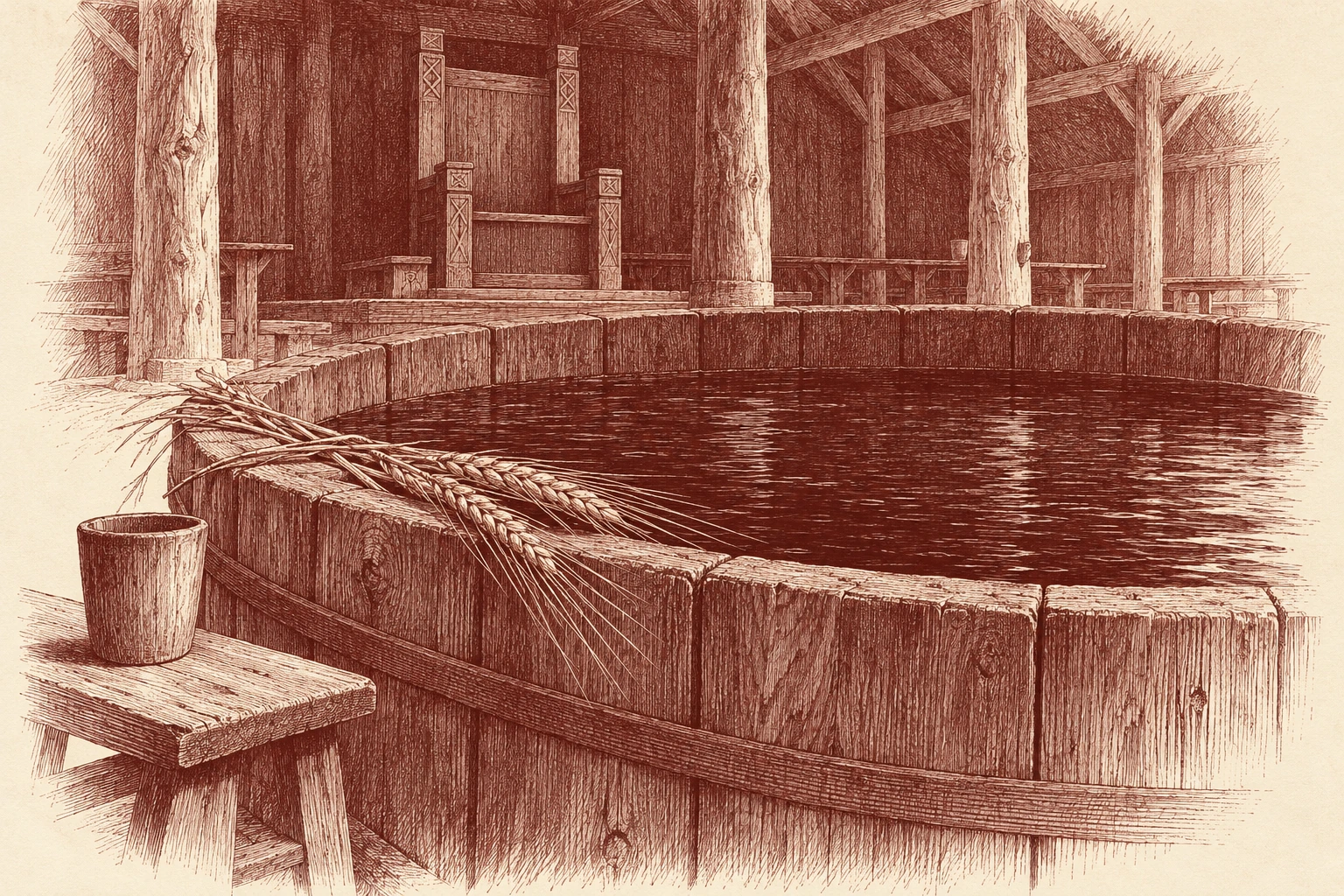
The death of a king in a vat of drink brings his body into the substance of the royal feast. What he receives as a guest, or distributes as a host, becomes the means of his disappearance; the abundance associated with kingship takes the king himself. Beside these stories, the John Barleycorn ballads describe the making of drink as the destruction of a person whose power continues after his body has been broken down. The grain and the king approach the vessel from different directions, but their meeting there invites a theological reading of the relationship between royal presence and the land’s increase.
We read this relationship through Ing, whose kingship we understand in the prosperity and frith of the people. Béow places barley within an English royal lineage; John Barleycorn gives the grain a body that suffers and becomes drink. The drowned kings carry the comparison into royal legend, while the drowning at the close of Ing’s procession gives withdrawal its place within a visitation that brings peace. These accounts belong to different periods and forms of telling. Read together, they allow us to consider how power can remain effective when the body through which it was known has changed or passed from sight.
Ing and the keeping of the land
In Ynglinga saga, Freyr also bears the name Yngvi, and Fróði’s peace begins during his reign. The blessings associated with him are prosperous seasons and peace, ár ok friðr. The account of sacrificial feasting in Hákonar saga góða gives these blessings a place in the drinking: cups are dedicated to Njörðr and Freyr for their continuance. The cup belongs within the religious work of keeping the land prosperous and its people secure.1
The year’s increase and the keeping of frith depend upon one another. Fields must yield, but their yield must also sustain households whose relationships endure beyond a single season. Kingship gives this dependence a public form; the ruler’s standing is bound to the condition of the people and the land from which they live. His hospitality makes that bond tangible. The harvest enters the hall as provision, and the company receives in the cup something of the abundance his rule is expected to maintain.
Brewing brings human labour into this relationship. What grows in the field passes through the hands of those who harvest, malt, and brew it; the drink gathers their work into a form that can be distributed. Beer can also be set apart for a god. Jonas of Bobbio describes a great vessel prepared for Wodan, which Columbanus disrupts. That brief witness places the brewing vessel among the things through which people approach divine powers.2 In the present reading, the cups of Freyr and the royal traditions surrounding him give that wider practice its particular relation to Ing.
Béow and the royal barley
The English royal tradition brings barley into this company through Béow, son of Scyld. His name means barley, and the opening of Beowulf presents him as an heir sent for the people’s comfort. After Scyld’s departure he rules as a beloved king, carrying the dynasty forward. The grain’s name thus stands within the royal lineage, attached to the provision of a ruler and the continuation of his people.3
Béow gives the agricultural meaning a royal bearer. Within our understanding of Sceafa and Scyld, his place in the succession joins the grain to the work of maintaining the established kingdom. The association is inherited in the name and genealogy; it gives our comparison an English foundation before we approach the later ballads. Read beside Béow, John Barleycorn brings the personified grain into the work by which a harvest becomes drink, giving bodily expression to a relationship already present in the royal name.
John Barleycorn beneath the water
The maltster begins with living barley. Steeping supplies the moisture that awakens germination; access to air keeps the grain viable while its growth begins. Kilning then arrests that growth and dries the malt. Mashing makes sugars available, and fermentation turns them into alcohol. The grain’s development is begun and then redirected; what might have become a rooted plant is worked into provision for the feast.4
In the language of the ballad, this immersion can become a drowning. The image describes the grain’s treatment as the treatment of a body, while successful malting requires the barley to remain alive through steeping. Water begins the change; the subsequent drying, grinding, and brewing complete the destruction of its former shape. A handful of grain has become something that can enter other bodies and act upon them.
An early English broadside of Sir John Barleycorn, preserved in the Pepys collection and dated approximately 1601–1640, makes the threat explicit: “Some said kill him, some said drowne.” The work that follows takes him through the field and into the maltster’s hands. He is steeped in a vat, spread out and turned, dried on a kiln, ground, and washed with hot liquid. His drink is barrelled and drawn off as blood; its intoxicating force finally overcomes those who thought to master him.5
Burns’s version places Barleycorn in a pit filled with water and leaves him to “sink or swim.” He is then laid upon a floor, turned while signs of life remain, heated, and ground. The drink made from him strengthens courage and relieves sorrow. Kings conspire against him at the beginning of the poem; at its close, a company drinks to him and wishes for the continuation of his line.6
Barleycorn’s power survives the work that destroys him. The broadside gives that power a vindictive humour, while Burns attends more closely to the benefits received by the drinkers. Both permit the same recognition: the body has been changed, and its capacity to affect others has become manifest in the drink. The personification remains close to material experience. The maltster’s floor and the miller’s stones explain his wounds; the company’s intoxication explains why his defeat can become a victory.
This is the ballads’ particular value for our theology. Their account of suffering makes visible the passage from living grain to a substance in which its effects continue. Read through Ing, the harvest’s destruction becomes part of the way his blessing reaches the people. The grain no longer stands in the field, but the land’s increase is present in the cup; the work that has ended one form of life has made its benefit available in another.
The king in the drink
Fjölnir’s death places this question within the family of Yngvi-Freyr. Snorri calls him Freyr’s son and describes his reign as prosperous and peaceful. Visiting Frið-Fróði at Lejre, Fjölnir becomes drunk, loses his way during the night, and falls into a great vat of mead. The son of Freyr dies within the hospitality of the king whose name is bound to peace.7
The mead widens the comparison to the abundance of the royal feast. Barley supplies one route from the field to the drinking vessel; the connection here concerns the king’s bodily entry into the provision associated with his office. His death places him within what ordinarily passes between rulers and their guests, making royal presence and the substance of hospitality occupy the same vessel.
Saxo’s Hundingus enters an ale-vat while performing that office himself. Having heard a false report of Hadingus’s death, he gathers his nobles for a commemorative feast. An enormous vessel of ale stands among them, and the king serves the drink. In the course of that service, he falls into the vessel and drowns.8 The host enters the provision he has made for his company; the giver is bodily overtaken by the gift.
The Faroese ballad Óðin í Ásgørðum ella Frúgvin Málníða gives the brewing vessel another royal victim. Veraldur, a son of Óðin, travels to seek a wife despite his father’s warning. A king in Zealand welcomes him to drink, but the invitation conceals a trap, and he falls into a brewing vat. Dumézil associates Veraldur with Freyr through the title veraldargoð, god of the world.9 Here the expected union of households ends in treacherous hospitality. Marriage and royal alliance provide the setting in which the guest disappears beneath the hall.
These deaths occur through accident or deceit. Their force for the present reading lies in the bodily relation they establish between the royal figure and the drink. The narratives do not themselves say that a harvest follows from a king’s drowning. We propose that the descent into the vessel can be understood as an image of royal power passing into the abundance with which it is associated. John Barleycorn supplies the clearest account of how such a transformation can be imagined: the figure is overcome, yet becomes effective within the drink that results.
Britt-Mari Näsström brings Fjölnir, Hundingus, and Veraldur together in her discussion of death in the vat, interpreting drowning through assimilation into the liquid and withdrawal into another realm. She also places these stories beside the drowning described by Tacitus at the close of the Nerthus rite.10 That comparison leads from the vessel of the feast to the water at which Ing’s public visitation ends.
The procession and the closing of access
Tacitus describes a covered vehicle drawn by cows and welcomed by several peoples, including the Anglii. Weapons are put away during the visitation, and peace prevails. After the return to the sanctuary, the vehicle, its covering, and, Tacitus adds, the deity are washed in a secluded lake. Enslaved attendants perform this service and are immediately swallowed by the same water. The account ends with the secrecy surrounding what they have seen.11
Ing’s movement through the country brings his presence among the people; the return to the sanctuary brings that public approach to an end. The washing belongs to this withdrawal. Those who serve at its most concealed moment are taken beyond the community’s reach, and what they have witnessed passes with them. The lake closes access to a divine presence whose visitation has already brought peace.
The order of events matters. The people receive the visitation before the attendants are drowned. We can read their deaths as the fatal completion of the rite, or as an offering accompanying its close, without making them the cause of the peace that preceded them. The attendants occupy their own place in the account; their service brings them to the water, while the royal figures enter it through the circumstances of a feast.
Beside the vat deaths, the lake gives drowning the meaning of final withdrawal. A body passes beneath the surface and becomes unavailable to those who remain. In our theological reading, that loss of access need not mean that the benefit associated with the presence has been exhausted. The visitation has ended, but the peace it has established belongs to the life of the country. The distinction between a presence that can be approached and a power whose effects continue supplies the connection with the transformed grain.
Ing in the abundance of the land
Béow places barley in the royal succession; the Barleycorn ballads give the grain a bodily history in which destruction and continuing power belong together. The drowned kings allow us to bring that history into conversation with the ruler’s relation to the feast. Their entry into the vessel becomes an image through which we can understand the king as bound to the provision that sustains his people, even when his separate bodily presence has disappeared.
The theology developed here locates Ing’s continuing presence in the life his blessing makes possible. The growing grain, the worked malt, and the drink received by the company are successive forms in which the year’s abundance reaches human beings. Royal power belongs within that dependence upon the land. Read through the drowned king, it can be imagined as entering the substance of provision itself; read through the procession, it can withdraw from direct approach while leaving its effects among the people.
The two images give a more particular meaning to the ale-vat blessing. The grain’s former body is gone, yet its strength is encountered in the drink. The king’s body disappears into the vessel, while the narrative leaves us to consider his relation to what it contains. We understand that conjunction through Ing: the divine king is present in the abundance by which the people continue, and the disappearance of a visible form need not bring his efficacy to an end. At the feast, ár is received in the cup and friðr is given expression among those who drink; the land’s increase has become an occasion on which Ing’s kingship is experienced.
Sources
Burns, Robert. “John Barleycorn.” Text reproduced by Sheffield Hallam University, lines 1–60. https://teaching.shu.ac.uk/ds/sle/Excerpts/burnsbarley.htm.
Dumézil, Georges. From Myth to Fiction: The Saga of Hadingus. Translated by Derek Coltman. Chicago: University of Chicago Press, 1973. Appendix I, “Hanging and Drowning.”
English Broadside Ballad Archive. “A pleasant new Ballad to sing both Euen and Morne, Of the bloody murther of Sir John Barley-corne.” Pepys Ballads 1.426, EBBA 20199. London: printed for H. G., approximately 1601–1640. https://ebba.english.ucsb.edu/ballad/20199. Related text: EBBA 31072.
Fulk, R. D., Robert E. Bjork, and John D. Niles, editors. Klaeber’s Beowulf and The Fight at Finnsburg. 4th ed. Toronto: University of Toronto Press, 2008. Lines 12–19 and 53–57, as reproduced in Grant, “Beow in Scandinavia.”
Grant, Tom. “Beow in Scandinavia.” Anglo-Saxon England 48 (2019): 105–120. Published online 2022. https://doi.org/10.1017/S0263675122000023.
Jonas of Bobbio. Vita Columbani, book 1, chapter 27. Latin text available through Monumenta, under Ionas Bobiensis, Vita Columbani, §53 in the Mabillon numbering.
Maltsters’ Association of Great Britain. “How Malt Is Made.” https://www.ukmalt.com/uk-malting-industry/how-malt-is-made/.
Näsström, Britt-Mari. “The Sacrifices at Uppsala: Christian Polemic or Ceremonies of the Old Norse Religion?” Cosmos 17 (2001): 99–112.
“Óðin í Ásgørðum ella Frúgvin Málníða.” CCF 79 C, stanzas 183–194. Snar, Faroese ballad collection. Source identified as Napoleon Nolsøe, Tórshavn, 1840. https://snar.fo/kvaedi/kappakvaedi/ccf-79-odin-i-asgoerdum-ella-frugvin-malnida/ccf-79-c.
Saxo Grammaticus. The First Nine Books of the Danish History of Saxo Grammaticus. Translated by Oliver Elton. London: David Nutt, 1894. Book 1.
Simpsons Malt. “Steeping Process” and “Kilning Process.” https://www.simpsonsmalt.co.uk/about-us/the-malting-process/.
Snorri Sturluson. Heimskringla. Vol. 1. Translated by Alison Finlay and Anthony Faulkes. 2nd ed. London: Viking Society for Northern Research, 2016. Ynglinga saga 10–11; Hákonar saga góða 14.
Tacitus. Germania, chapter 40. Latin text: https://www.lateinlex.de/?call=Puc&permalink=Tac_Germ_40.
Footnotes
Snorri Sturluson, Ynglinga saga 10 and Hákonar saga góða 14, in Heimskringla, vol. 1, trans. Alison Finlay and Anthony Faulkes, 2nd ed. (London: Viking Society for Northern Research, 2016), pp. 13–14 and 98–99. Ár ok friðr gives the nominative form; the purpose of the offering is expressed as til árs ok friðar.
Return to textJonas of Bobbio, Vita Columbani I.27, the episode at Bregenz; also numbered §53 in the Mabillon text reproduced by Monumenta. The people identify the recipient as Wodan. Columbanus blows upon the vessel, which bursts.
Return to textBeowulf, lines 12–19 and 53–57, in Klaeber’s Beowulf and The Fight at Finnsburg, ed. R. D. Fulk, Robert E. Bjork, and John D. Niles, 4th ed. (Toronto: University of Toronto Press, 2008). For the name’s meaning and the royal genealogies, see Tom Grant, “Beow in Scandinavia,” Anglo-Saxon England 48 (2019): 105–120, opening discussion, which reproduces these passages from the edition.
Return to textMaltsters’ Association of Great Britain, “How Malt Is Made”; Simpsons Malt, “Steeping Process” and “Kilning Process.” These accounts explain the need to keep grain viable during steeping and germination before kilning arrests its growth.
Return to text“A pleasant new Ballad to sing both Euen and Morne, Of the bloody murther of Sir John Barley-corne,” Pepys Ballads 1.426, English Broadside Ballad Archive 20199, catalogue and text transcription. EBBA dates the copy 1601–1640 with a question mark. Compare the related Roxburghe text, EBBA 31072. The ballads are used here as poetic analogues; the comparison does not depend upon demonstrating their direct descent from a heathen rite.
Return to textRobert Burns, “John Barleycorn,” especially lines 33–60, in the text reproduced by Sheffield Hallam University. The immersion, malting floor, heating, and milling occur in lines 33–44.
Return to textSnorri, Ynglinga saga 11, in Finlay and Faulkes, Heimskringla, vol. 1, p. 15. The prose specifies mead. Fjölnir’s death is also the subject of the Ynglingatal stanza cited there.
Return to textSaxo Grammaticus, Gesta Danorum, book 1, closing episode of Hundingus and Hadingus; see The First Nine Books of the Danish History of Saxo Grammaticus, trans. Oliver Elton (London: David Nutt, 1894).
Return to text“Óðin í Ásgørðum ella Frúgvin Málníða,” CCF 79 C, stanzas 183–194, text and source information at Snar; the record identifies Napoleon Nolsøe, Tórshavn, 1840, as its source. The vessel is bryggjukar, a brewing vat; its contents are not expressly identified. For Veraldur’s association with Freyr, see Georges Dumézil, From Myth to Fiction: The Saga of Hadingus, trans. Derek Coltman (Chicago: University of Chicago Press, 1973), appendix I, especially pp. 134–137. The identification is Dumézil’s interpretation. For Freyr’s title veraldargoð, see Ynglinga saga 10, in Finlay and Faulkes, p. 14.
Return to textBritt-Mari Näsström, “The Sacrifices at Uppsala: Christian Polemic or Ceremonies of the Old Norse Religion?” Cosmos 17 (2001): 99–112, especially pp. 106–109.
Return to textTacitus, Germania 40. Bubus feminis specifies female cattle, hence cows. Tacitus gives no precise account of the means of drowning and does not say that the attendants impersonate the deity. The interpretation of the final deaths as an offering accompanying withdrawal is developed here from the sequence he describes.
Return to text